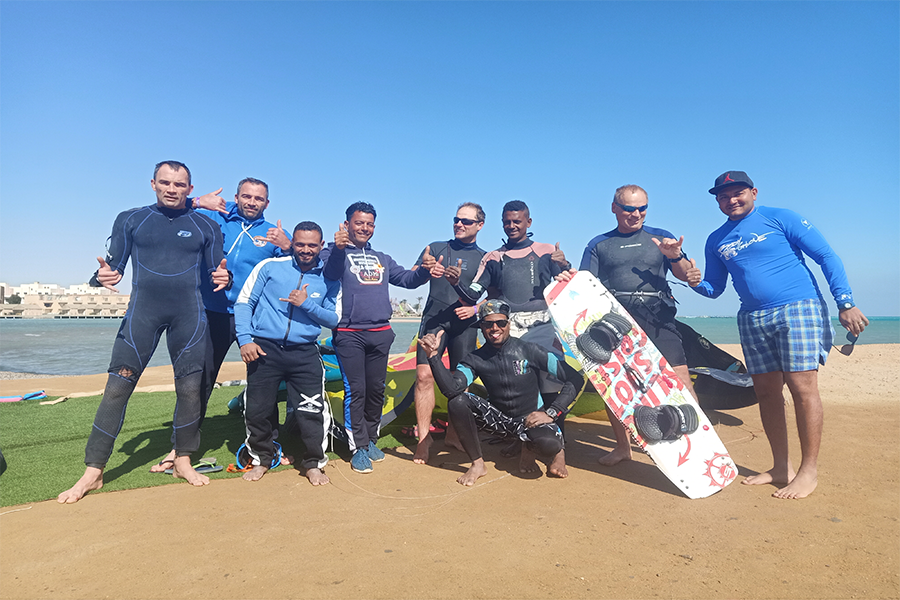
Masters Surf School, located within the Titanic Hotel complex in Hurghada, Egypt, provides IKO-certified kitesurfing and windsurfing instruction in one of the Red Sea’s most reliable wind corridors. The spot features a shallow, sandy-bottom lagoon ideal for beginners, with consistent thermal winds averaging 18–25 knots from March through November. With over 25 years of operational experience and multiple Red Sea locations, the school offers structured lesson progression, equipment rental, and complimentary hotel transfers—making it a turnkey water sports destination for both first-timers and experienced riders seeking progression in safe, controlled conditions.
Kitesurfing at Titanic Hotel Hurghada: The Complete Guide to Masters Surf School
- 🌊 What Kitesurfing Is and How It Works
- 🏨 What Kitesurfing Options Are Available at Titanic Hotel Hurghada
- 📚 Lesson Structure and IKO Progression
- 🏄 What Windsurfing School Options Are Available at Titanic Hotel
- ✅ What Else You Should Know Before Visiting
- ❓ Frequently Asked Questions About Kitesurfing at Titanic Hotel Hurghada
- 📞 Ready to Start Your Kitesurfing Journey?
🌊 What Kitesurfing Is and How It Works
Kitesurfing is a water sport that combines elements of surfing, wakeboarding, and paragliding, where a rider uses a controllable kite to harness wind power and glide across the water on a small board.
The rider wears a harness connected to a control bar, which is attached to an inflatable kite via four or five lines. By manipulating the bar—pulling in to increase power, pushing out to depower, and steering left or right—the rider controls both the kite’s position in the wind window and the direction of travel. The board, typically a twin-tip design that works equally well in either direction, is strapped to the rider’s feet. This configuration allows for planing across the water surface at speeds that can exceed 30 knots, as well as performing aerial maneuvers when the kite generates sufficient lift.
How kitesurfing generates propulsion: The kite functions as an airfoil, creating lift as wind flows over its curved surface. This lift force is transferred through the lines to the rider’s harness, pulling them across the water. By edging the board against the water’s resistance, the rider converts this pull into forward momentum—a principle known as apparent wind, where the rider’s own movement effectively increases the wind speed felt by the kite.
Essential equipment required for kitesurfing:
- 🪁 Kite (inflatable leading-edge design): The primary airfoil that captures wind energy; sizes range from 5m² to 17m² depending on wind strength and rider weight.
- 🎮 Control bar and lines: The rider’s interface with the kite, featuring a quick-release safety system and adjustable trim for depowering.
- 🦺 Harness (waist or seat style): Distributes the kite’s pulling force across the rider’s body, reducing arm fatigue.
- 🏄 Board (twin-tip or directional): A small, buoyant platform with foot straps or bindings.
- 🪖 Safety gear: Impact vest or buoyancy aid, helmet, and in some conditions, a wetsuit.
🏨 What Kitesurfing Options Are Available at Titanic Hotel Hurghada
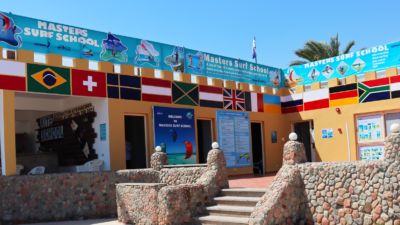
Masters Surf School, operating directly from the Titanic Hotel on Sahl Hashish Road, offers a comprehensive range of kitesurfing services including beginner courses, advanced coaching, equipment rental, and guided excursions—all supported by IKO-certified instructors and purpose-built facilities.
🎯 School Overview and Credentials
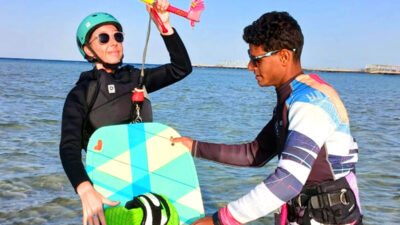
Masters Surf School brings over 25 years of water sports experience to Hurghada’s coastline, with operations spanning more than four Red Sea locations. The school’s instruction follows the International Kiteboarding Organization (IKO) curriculum, ensuring standardized, safety-focused teaching methods recognized globally. IKO certification means students progress through structured levels—from Discovery (first experience with a trainer kite) through Intermediate and ultimately Independent rider status—with each milestone documented on an IKO Kiteboarder Card that is accepted at schools worldwide.
The school operates daily from 8:30 AM to 7:00 PM, with facilities directly accessible from the Titanic Hotel beach. Students benefit from radio-assisted instruction during water sessions, allowing real-time feedback and safety oversight even when the instructor is positioned on shore or on a support boat.
📞 Contact Information and Booking
| Contact Method | Details |
|---|---|
| Primary Phone | +20 112 482 3398 |
| Secondary Phone | +20 127 228 4800 |
| masters.surfschool@gmail.com | |
| Website | |
| Physical Address | Titanic Hotel, Sahl Hashish Rd, Red Sea Governorate, Hurghada 84511, Egypt |
How to book lessons: Reservations can be made directly through the school’s website, by email, or via phone. Advance booking is recommended during peak wind season (April–October) to secure preferred lesson times and equipment availability. The school offers complimentary hotel transfers for students staying at properties beyond the Titanic complex, extending the service area to most Hurghada accommodations.
🌬️ Wind Conditions at Titanic Hotel Hurghada
The kitesurfing spot at Titanic Hotel offers a shallow, sandy-bottom lagoon with consistent side-onshore winds, creating ideal learning conditions for beginners and reliable sessions for intermediates.
The Red Sea’s geography creates a natural wind funnel, with thermal winds generated by temperature differentials between the desert interior and the cooler sea surface. This phenomenon produces predictable wind patterns that blow predominantly from the north/northeast, running diagonally toward the shore—a direction known as side-onshore wind. This orientation is considered optimal for kitesurfing because it pushes riders toward the beach rather than out to open water, significantly reducing the risk of offshore drift.
Wind season breakdown:
| Period | Wind Conditions | Suitability |
|---|---|---|
| March–November | 18–25 knots consistent | Prime kitesurfing season; 80% kiteable days in peak months |
| May–October | Strongest and most consistent; often daily wind | Ideal for all levels; thermal winds pump nearly all day |
| December–February | Lighter winds, 15 knots average | Suitable for lessons and larger kites; water cooler |
The lagoon’s shallow depth—waist-high for extended distances—allows beginners to stand and recover during body-dragging exercises and water-start attempts. This feature accelerates learning because students can focus on kite control without managing deep-water anxiety. The sandy bottom eliminates injury risk from coral or rocks, while the natural reef barrier offshore suppresses wave action, maintaining flat-water conditions even when winds are strong.
📚 Lesson Structure and IKO Progression
A standard kitesurfing course at Masters Surf School follows the IKO Level 1 through Level 3 progression, taking most beginners from zero experience to independent riding in approximately 9–12 hours of instruction spread across 3–5 days.
Level 1: Discovery (2–4 hours, on land and shallow water)
- 1A – Site assessment and safety systems: Students learn to identify safe wind directions, recognize spot hazards, set up a trainer kite, and operate the quick-release safety mechanisms.
- 1B – Basic kite flying: Developing fundamental flying skills with a trainer kite, including launching, landing, walking while flying, and understanding the wind window.
- 1C – Full-size kite setup: Assembling a 4- or 5-line de-power kite, performing pre-flight safety checks, and mastering international communication signals.
- 1D – Harnessed control: Controlling the kite while hooked into the harness and demonstrating proficiency with the de-power system.
- 1E – Emergency procedures: Executing a quick-release activation and performing a self-landing.
the Level 2: Intermediate (9–12 hours, in water)
- 2F – Water entry and body dragging: Entering and exiting the water safely, water-relaunching the kite, and performing downwind body drags.
- 2G – Upwind body dragging: Recovering the board and dragging upwind while holding the board with one hand.
- 2H – Water start preparation: Understanding the power stroke required for water starts and positioning the board correctly.
- 2I – First rides: Executing water starts in both directions, riding short distances, and coming to controlled stops. Students also learn right-of-way rules and how to assess weather conditions.
Level 3: Independent
- 3J–3L – Refinement: Controlling riding speed by edging, riding upwind consistently, changing direction without stopping, and performing self-rescue procedures.
Cost expectations for lessons: In Hurghada, kitesurfing lessons typically range from $60–$70 per hour for private instruction, with comprehensive beginner packages of 10–12 hours priced between $300–$500—significantly more affordable than comparable European destinations like Tarifa, Spain.
🪁 Equipment Rental and Storage
Masters Surf School maintains a fleet of modern kitesurfing equipment available for rent to certified independent riders, with storage facilities on-site for guests bringing personal gear.
Rental equipment includes kites from leading manufacturers, twin-tip boards in various sizes, harnesses, helmets, and impact vests. Students enrolled in lessons use school equipment at no additional charge during instruction hours. Independent riders must present valid IKO certification (Level 3 or equivalent) to rent equipment without supervision.
Equipment storage and services:
- Daily and weekly rental packages available
- Secure overnight storage for personal kites and boards
- Pump station for inflating kites
- Rinse area for gear maintenance
- Repair service for minor equipment issues
🌟 What Is a Kite Safari and Where Does It Go
A kite safari is a multi-day guided excursion where participants travel by boat to remote, uninhabited islands and reef locations north of Hurghada, accessing pristine kitesurfing conditions with stronger, cleaner wind than found at mainland spots.
Masters Surf School organizes kite safaris that take riders to islands such as Tawila, Geisum, and Ashrafi, located offshore in the Red Sea. These locations offer several distinct advantages over beach-based kiting:
- Wind amplification: Open-sea wind averages 4–5 knots stronger than mainland readings, with historical averages of 80% kiteable days during May through October.
- Unobstructed airflow: Wind traveling across open water encounters no terrain interference, producing exceptionally clean, non-gusty conditions.
- Butter-flat lagoons: Shallow, protected areas behind reef formations create mirror-smooth water ideal for freestyle progression and foiling.
- Downwinders: Participants can ride point-to-point along island chains, covering distances not possible from fixed beach locations.
Safari durations vary from single-day excursions to weeklong liveaboard experiences, with all logistics—including boat transport, meals, and safety support—coordinated by the school.
🏄 What Windsurfing School Options Are Available at Titanic Hotel
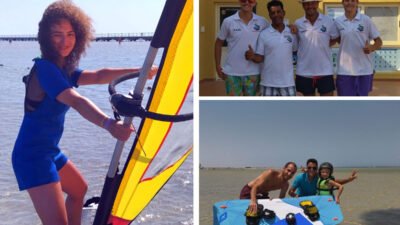
In addition to kitesurfing, Masters Surf School operates a fully equipped windsurfing school at Titanic Hotel, offering instruction for beginners through advanced riders using modern equipment and certified teaching methods.
🎯 Windsurfing vs. Kitesurfing: How the Learning Curves Compare
| Aspect | Windsurfing | Kitesurfing |
|---|---|---|
| Initial learning phase | Gradual; first sessions involve standing on a large board with a small sail at displacement speeds | Steeper; first hours dedicated to land-based kite control before entering water |
| Time to first ride | 5–10 hours to ride consistently on flat water | 8–12 hours to achieve water starts and short rides |
| Path to advanced skills | Longer progression; reaching harness and foot-strap proficiency can take years | Faster progression once fundamentals are mastered; advanced tricks like jumping become accessible sooner |
| Physical demands | More upper-body strength required for sail handling; core stability for balance | Power distributed through harness; less continuous arm strain but requires kite awareness and coordination |
| Safety considerations | Generally lower risk; sail can be released quickly if overpowered | Higher inherent risk due to kite power; safety systems and proper instruction essential |
Which sport is right for you? The choice between kitesurfing and windsurfing depends on individual preferences. Windsurfing appeals to those who prefer a more gradual introduction to wind sports, enjoy the technical challenge of sail trim and board handling, or have concerns about managing kite power. Kitesurfing attracts riders seeking faster progression to planing speeds and aerial maneuvers, value equipment portability, and appreciate the sensation of being pulled by an overhead kite rather than holding a sail.
📚 Windsurfing Lesson Options
The windsurfing school offers structured instruction using similar pedagogical principles as the kitesurfing program:
- Beginner courses: Introduction to equipment, basic stance, steering, and turning on a stable, high-volume board with a small sail.
- Intermediate coaching: Harness use, foot-strap entry, planing techniques, and beach starts.
- Advanced clinics: Carving jibes, water starts, and wave-riding fundamentals.
- Equipment rental: Wide selection of boards and sails available for certified independent windsurfers.
The same shallow lagoon that benefits kitesurfing beginners also provides ideal conditions for windsurfing instruction—students can stand and reposition easily after falling, and the flat water surface eliminates the variable of wave management during early skill acquisition.
✅ What Else You Should Know Before Visiting
🚗 Complimentary Services and Logistics
Masters Surf School provides complimentary hotel transfers for students, eliminating transportation concerns and making the school accessible from most Hurghada accommodations.
The transfer service covers pickup and return to hotels throughout the Hurghada area, with specific coverage extending to properties along the Sahl Hashish Road corridor and beyond. Students should confirm transfer availability when booking and provide their hotel name and room number for coordination.
🏖️ Facilities and Amenities at Titanic Hotel
The Titanic Beach Spa & Aqua Park and adjacent Titanic Palace form a connected resort complex, allowing guests to access amenities from both properties. Relevant features include:
- Direct beach access: The kitesurfing center is situated on the hotel’s private beach, eliminating travel time between accommodation and lessons.
- Shallow water entry: The beach features a long, gradual slope into the water, with waist-deep conditions extending far from shore—ideal for water sports instruction.
- Beach amenities: Sun loungers, shade umbrellas, a beach bar, and a small restaurant serve the kitesurfing area.
- Spa and aqua park: One of Hurghada’s largest water parks with multiple slides, wave pool, and rafting river; spa facilities include massage rooms and saunas for post-session recovery.
- Additional water sports: Water skiing, jet skiing, banana boat rides, and snorkeling excursions to the nearby reef are available.
📅 Best Times to Plan Your Visit
For optimal kitesurfing conditions, schedule your trip between April and October, when Hurghada experiences its strongest and most consistent thermal winds.
The peak wind window runs from May through October, with historical data showing 80% kiteable days and typical wind speeds of 18–25 knots. During this period, water temperatures range from 26–30°C (79–86°F), making wetsuits optional for most riders—though a shorty or lycra provides sun protection and minor abrasion resistance.
Shoulder months (March–April and November) remain viable for kitesurfing, with slightly less consistent wind but also smaller crowds and more flexible booking availability. Winter months (December–February) bring lighter winds averaging around 15 knots and cooler water (22–23°C), still suitable for lessons and larger kites but requiring a 3mm wetsuit for comfort during extended sessions.
⚠️ Important Safety and Booking Considerations
Booking with an IKO-certified school ensures that safety systems, spot assessment, and emergency procedures are taught to internationally recognized standards.
Before booking, verify the following:
- Confirm current lesson availability directly with the school, particularly during peak months when demand exceeds capacity.
- Independent riders must present valid certification (IKO Level 3 or equivalent) to rent equipment.
- Bring sun protection—high-SPF sunscreen, rash guard or lycra, polarized sunglasses, and a hat for between-session breaks.
- Hydration is critical; the combination of sun, wind, and physical exertion accelerates fluid loss.
- Check visa requirements for Egypt; most nationalities can obtain a tourist visa on arrival at Hurghada International Airport.
❓ Frequently Asked Questions About Kitesurfing at Titanic Hotel Hurghada
No prior experience is required. The school’s beginner courses start from absolute zero, covering land-based kite control before any water entry. Approximately 90% of students arrive as complete novices.
Most beginners achieve independent riding—water starts and controlled riding in both directions—after 9–12 hours of instruction spread across 3–5 days. Individual progression varies based on factors including prior board sport experience, comfort in water, and wind conditions during lessons.
Yes, the combination of shallow water, sandy bottom, side-onshore wind direction, and IKO-certified instruction with radio communication creates a controlled learning environment. The safety systems taught during initial lessons enable riders to instantly depower the kite if needed.
Bring swimwear, a towel, high-SPF sunscreen, sunglasses with a retention strap, and a reusable water bottle. The school provides all necessary equipment—kite, board, harness, helmet, and impact vest—during lessons.
Yes, children aged approximately 12 and older, depending on weight and swimming ability, can participate in lessons. IKO guidelines recommend a minimum weight of 40–45 kg (88–99 lbs) for safe kite control. The school offers smaller kites and boards appropriate for youth riders.
No, the school welcomes guests from all Hurghada accommodations. Complimentary transfer service is provided from most area hotels.
The school maintains flexible rescheduling policies for lessons affected by insufficient wind. Students are not charged for sessions that cannot run due to weather conditions, and every effort is made to accommodate makeup sessions within the guest’s available dates.
Yes, equipment rental is available for certified independent riders who can demonstrate competency. IKO Level 3 certification (or equivalent) is typically required. Renters assume responsibility for equipment and must sign liability waivers.
Titanic Beach Spa & Aqua Park and Titanic Palace are connected resort properties that share amenities and beachfront. The kitesurfing center is accessible from both hotels, with the beach and lagoon serving both properties equally.
Kite safaris are generally recommended for intermediate and advanced riders who can ride upwind consistently and perform self-rescue procedures. The remote locations involve deeper water and fewer support resources than the main school lagoon, making independent competency essential.
📞 Ready to Start Your Kitesurfing Journey?
🌊 Book your lesson today and experience the Red Sea’s most reliable kitesurfing conditions with Hurghada’s premier IKO-certified school.
Contact Masters Surf School to reserve your spot during peak wind season. Spots fill quickly from April through October—secure your dates now to guarantee availability.
Masters Surf School
Red Sea Governorate,
Secondary phone: +201272284800
Email: masters.surfschool@gmail.com
Complimentary hotel transfers included with every booking.
[…] biggest asset here is the spot itself. The Titanic Hotel lagoon is a unique geographical feature. It’s not just “shallow”—it’s a massive, […]
[…] Windsurfing & Kitesurfing at Titanic Hotel Hurghada […]