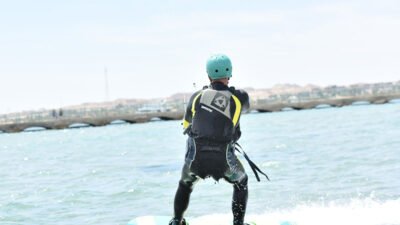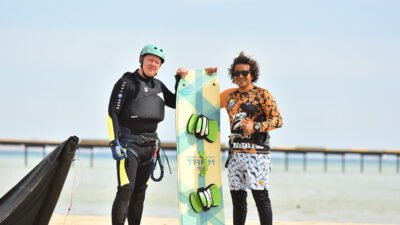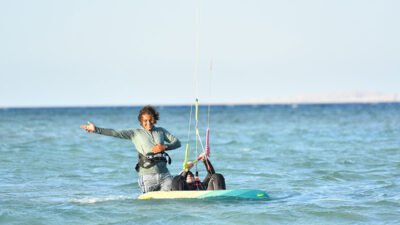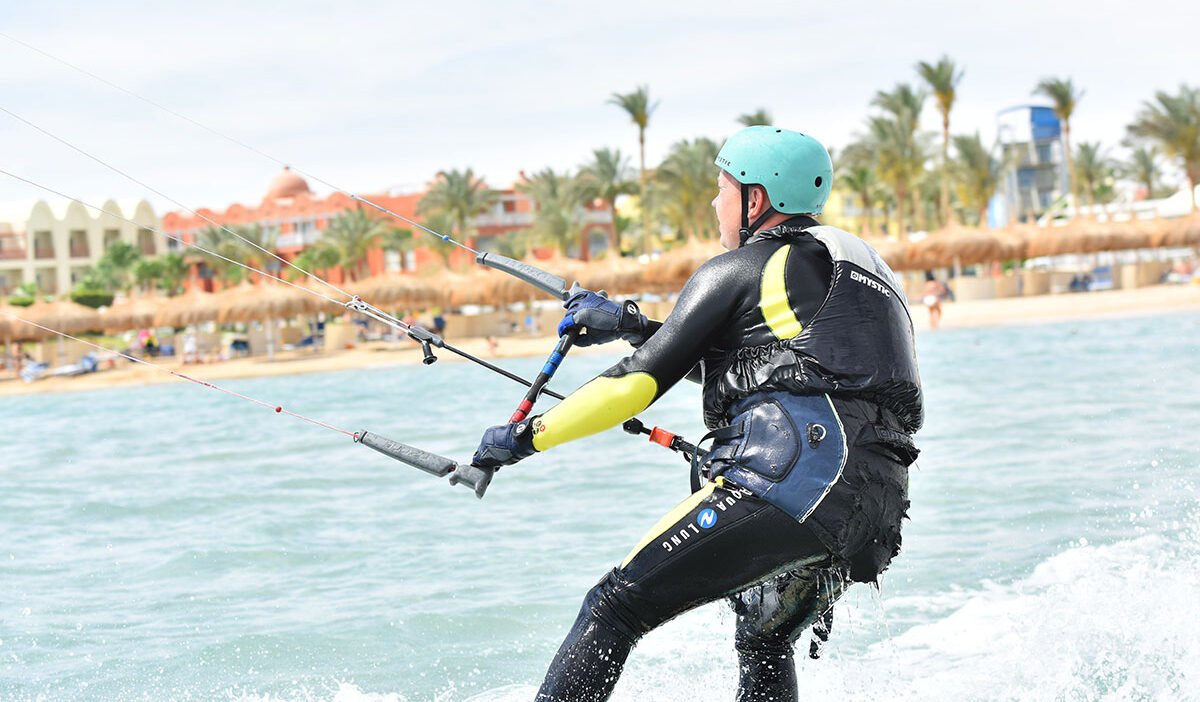
Kite Surf in Hurghada, Egypt, is one of the world’s premier kitesurfing destinations because it offers a rare combination of consistent thermal winds (15–25 knots), shallow flat-water lagoons, and warm water year-round. The 2026 season runs from March to November, with peak conditions May through October. IKO-certified schools such as Masters Surf School provide structured training, premium equipment, and free hotel transfers. Students typically ride independently in 3–6 days.
What Is Kitesurfing, and How Does It Work?
Kitesurfing (also called kiteboarding) is a water sport in which a rider stands on a small board and is pulled across the water by a large, controllable kite. The kite is steered using a control bar connected by lines; the rider harnesses wind power to glide, jump, and perform tricks.
Think of it as a triangle of forces: the kite captures the wind, the board planes over the water, and the rider’s body acts as the connection point. You do not need to be exceptionally strong—the harness transfers the kite’s pull to your waist, leaving your arms for steering only. Modern kites include a quick-release safety system that instantly depowers the kite if the rider lets go of the bar, a foundational safety feature every student learns in their first lesson.
🌬️ Did you know? A 75 kg (165 lb) rider at Hurghada’s average wind speeds uses a 9–10 m² kite. On lighter days, a 12 m² kite extends the session.
Why Is Hurghada Considered One of the Best Places in the World to Learn Kite Surfing?
Hurghada is a top-tier learning destination because of its unique geography: a large, reef-protected lagoon with waist-deep, flat water and steady side-onshore winds. These conditions eliminate the two biggest obstacles for beginners—deep water fear and wave interference.
The Al Ahyaa Lagoon, north of the city center, is the centerpiece. A natural coral reef acts as a breakwater, flattening the sea surface and creating an enormous area of calm water. The sandy bottom means students can stand up at any point, recover their board easily, and focus entirely on kite control. The wind direction is predominantly north to north-northwest, blowing side-onshore—meaning it pushes the rider along the shoreline, not out to the open sea. This adds a critical safety margin.
In a 2026 comparison of Red Sea kitesurfing spots, Hurghada was ranked among the best in Egypt for its wide riding area, reliable thermal winds, and accessible infrastructure. Masters Surf School, operating from multiple locations along the coast, has over 25 years of experience guiding complete beginners through these conditions.
🏄 Key takeaway: Hurghada offers more rideable days per year (300+) than nearly any European destination, with warmer water and lower lesson prices.
When Is the Best Time of Year to Kite Surf in Hurghada in 2026?
The best months for kite surf in Hurghada are May through October, when the wind is most consistent, averaging 15–25 knots and blowing almost daily.
The primary wind season extends from March to November, but the peak is the six-month window from May to October. During this period, thermal winds—generated when desert heat pulls cool marine air inland—produce reliable northerly winds nearly every afternoon. Historical data from the Red Sea islands north of Hurghada show an 80% kiteable-wind rate during these months.
Below is a month-by-month guide for 2026:
| Month | Wind Range | Reliability | Water Temp | Suit Recommendation |
|---|---|---|---|---|
| March–April | 12–20 knots | Moderate (shoulder season) | 23–25°C (73–77°F) | 2mm shorty or long-sleeve lycra |
| May–June 🌟 | 15–25 knots | High | 25–27°C (77–81°F) | Board shorts + rash guard |
| July–August 🌟 | 18–30 knots | Very High | 27–29°C (81–84°F) | Board shorts + rash guard |
| September–October 🌟 | 15–25 knots | High | 26–28°C (79–82°F) | Board shorts + rash guard |
| November | 12–18 knots | Moderate (shoulder) | 24–25°C (75–77°F) | 2mm shorty |
| December–February | 10–18 knots | Unreliable (off-season) | 22–23°C (72–73°F) | 3/2mm full wetsuit |
Sources:
2026 Travel Note: Orthodox Easter falls on 12 April 2026, and Ramadan concludes around 20 March 2026—periods when schools may be busier. Book ahead for peak-season slots.
What Are the Wind and Water Conditions Like for Kite Surf Hurghada?
The wind in Hurghada is predominantly north to north-northwest, side-onshore, and thermally driven during the peak season. Water temperatures range from 22°C in winter to 29°C in summer—meaning a wetsuit is optional for most of the year.
Understanding the science helps you plan. Thermal wind works like this: during the day, the sun heats the Egyptian desert east of the Red Sea. Hot air over the land rises, creating a low-pressure zone. Cooler, denser air from over the sea rushes in to fill the void. The result is a steady, predictable airflow—typically building from late morning and holding strong through sunset.
Key numbers:
- Average wind speed (peak season): 15–25 knots. Stronger days can reach 30–35 knots for advanced riders.
- Off-peak wind (winter): 12–18 knots. Less reliable, gustier, driven by frontal systems rather than thermals.
- Most-used kite sizes for a 75 kg rider: 9–10 m² (peak season), 12 m² (lighter days).
- Sea temperature range: 22°C (March) to 29°C (August).
A crucial local tip: because the air over the Red Sea is hot and less dense, you typically need a kite one square meter larger than you would at a European spot at the same wind speed. Schools like Masters Surf School stock a full quiver of sizes and brands, so instructors can match equipment to the conditions of the day.
What Does a Typical Kitesurfing Lesson in Hurghada Involve?
A structured kitesurfing lesson follows the IKO (International Kiteboarding Organization) progression—starting with beach theory and a small trainer kite, advancing to body dragging in water, and finally board starts, all over 10–12 hours of instruction.
Professional schools in Hurghada follow a standardized, internationally recognized curriculum. Here is the step-by-step breakdown:
Level 1: Discovery (Land-Based, Hours 1–3)
You begin on the beach, not in the water.
- Theory (30–45 minutes): The instructor explains the “wind window”—the three-dimensional zone in the sky where the kite can fly and generate power. You learn the safety systems: quick-release mechanism, safety leash, and self-rescue procedures.
- Trainer kite flying (1–2 hours): Using a small 2–3 m² kite, you build muscle memory for steering—left/right, power strokes, and parking the kite at neutral (12 o’clock). Standing on sand, you can make mistakes without consequence.
- Equipment familiarization: You handle a full-size kite, learn to set up lines, and practice launching and landing with an instructor or beach assistant.
Level 2: Water Skills (Hours 4–8)
You enter the waist-deep lagoon—and you can stand at all times.
- Body dragging: Without a board, you lie in the water and let the kite pull you. This teaches you how to generate power and manage speed using only the control bar. Because Hurghada’s lagoon is shallow and sandy-bottomed, you can stop and stand whenever you need a break.
- Water relaunch: Kites inevitably fall into the water. You learn the technique to get the kite airborne again from the water’s surface—one of the most important skills for independence.
- Board handling: You practice putting the board on your feet while managing the kite with one hand.
Level 3: First Rides (Hours 9–12)
This is where it all clicks.
- Water start: The instructor teaches you the coordinated movement—dive the kite into the power zone, rise out of the water, and distribute weight to plane.
- Riding both directions: You practice controlled runs left and right.
- Independent riding: By the end of a 12-hour course, most students can ride independently and change direction. You receive an IKO Level 2 certification, recognized at kite spots worldwide.
Masters Surf School offers semiprivate lessons (maximum 1 student per instructor) with radio helmets for real-time coaching, plus free hotel pickup from any accommodation in Hurghada.
How Much Do Kitesurfing Lessons Cost in Hurghada in 2026?
In 2026, a 10–12 hour beginner kitesurfing course in Hurghada costs between $400 and $560 (€370–€520). Private hourly lessons range from $60 to $70 per hour. These prices include all equipment, and many schools add free hotel transfers.
Compared to European destinations, Hurghada delivers exceptional value:
| Course Type | Hurghada (2026) | Tarifa, Spain (2026) | Savings |
|---|---|---|---|
| 12-hour beginner course (private) | $400–$560 | $800–$1,200 | ~50% |
| Private hourly lesson | $60–$70 | $90–$120 | ~40% |
| 2-hour intro/taster | $63–$100 | $130–$180 | ~50% |
| 7-day kite safari (liveaboard) | €1,250 | €2,000+ | ~40% |
Sources:
What’s typically included in a course package:
- Full equipment rental (kite, board, harness, helmet, life vest)
- IKO-certified instructor for all sessions
- IKO certification card upon completion
- Free hotel transfers (at most major schools)
- Soft drinks and tea/coffee during sessions
To maximize value, book multi-day packages rather than hourly sessions, travel in the shoulder seasons (March/April or November) for lower accommodation costs, and book directly with IKO-certified schools rather than through third-party aggregators.
What Equipment Do I Need to Start Kite Surfing in Hurghada?
Beginners do not need to buy any equipment. All reputable kite schools in Hurghada provide the full set—kite, control bar, board, harness, helmet, and life vest—as part of the lesson package.
Here is what each piece does:
- Kite (leading-edge inflatable): The engine. A strut-inflated canopy that captures wind. Schools stock a full range of sizes (6 m² to 14 m²) so the right kite can be matched to the day’s wind.
- Control bar and lines: The steering wheel. Four or five lines (20–27 meters long) connect the bar to the kite. Pulling the bar in (“sheeting in”) increases power; pushing out reduces it.
- Harness: Worn around the waist or seat, the harness transfers the kite’s pull from your arms to your core. Most beginners start with a seat harness for extra support.
- Twin-tip board: Symmetrical in shape, can be ridden in either direction. Beginner boards are wider and flatter, making them easier to plane.
- Safety leash: A secondary line connecting the rider to a safety system that depowers the kite if the control bar is released.
- Helmet and impact vest: Essential safety gear required by all IKO-accredited schools.
Leading global brands—Duotone, Cabrinha, Core, North, F-One, and Ozone—are standard at Hurghada schools. Masters Surf School maintains top-quality, well-serviced gear from these premium manufacturers.
If you do decide to purchase personal gear, the basic starter kit (used/new) totals roughly $1,300–$2,200. Renting first and buying later is the recommended path.
How Do I Choose the Best Kite Surf in Hurghada School?
The best kite surf school in Hurghada should have IKO-certified instructors, a location on a shallow flat-water lagoon, semiprivate or private lesson structures, transparent pricing, and included services like equipment and transfers.
Use this checklist when evaluating:
| Criterion | What to Look For | Why It Matters |
|---|---|---|
| Certification | IKO or VDWS accredited | Guarantees standardized, safety-focused teaching |
| Location | Lagoon with waist-deep, flat water | Accelerates learning; allows standing at all times |
| Instructor ratio | 1:1 (private) or max 2:1 (semiprivate) | More personal attention = faster progress |
| Equipment | Modern, well-maintained gear from known brands | Safer, easier-to-fly kites reduce frustration |
| Transfers included | Free pickup from any Hurghada hotel | Eliminates hidden costs |
| Languages | Multilingual instruction | Clear communication of safety-critical instructions |
| Insurance & licensing | Fully insured, licensed operator | Legal protection; recourse in emergencies |
Masters Surf School meets all these criteria: IKO-certified, multilingual instructors (English, Arabic, German, Russian, Italian); four locations on the Red Sea coast; semiprivate lessons (max 1:1); free hotel transfers; and over 25 years of local experience.
Red flags to avoid: schools that push for large group lessons (5+ students per instructor), use visibly worn or damaged gear, or cannot show an IKO/VDWS certificate upon request.
Is Kitesurfing Safe for Beginners in Hurghada?
Yes—when taught by certified instructors in a controlled lagoon environment, kitesurfing in Hurghada has an excellent safety record. The combination of side-onshore wind, shallow water, and modern quick-release safety systems creates a low-risk learning environment.
The key safety features built into Hurghada’s setup:
- Side-onshore wind: The wind blows from the sea toward the land at an angle. If a student loses control, the wind naturally pushes them back to shore—not out to the open ocean. This is arguably the single most important safety factor for learning.
- Shallow lagoon: With depths rarely exceeding chest height and a sandy bottom, students can always stand, walk, and recover their equipment without swimming.
- Modern kite safety systems: All kites used in IKO schools have a quick-release mechanism. Letting go of the bar depowers the kite instantly, reducing the pull to near zero. A safety leash keeps the kite attached but flagged out (no power). These are drilled in the first 30 minutes of every lesson.
- Rescue protocols: Professional schools maintain a rescue boat on standby and use radio communication helmets so instructors can guide students verbally in real time. Some centers also use a radio-based rescue system for experienced riders who venture further out.
- Spot briefing: Before anyone enters the water, instructors brief students on entry/exit zones, right-of-way rules, and any hazards. Kiting zones are clearly demarcated from swimming areas.
Beginners are never sent into deep water or strong waves. Progression is paced: you do not advance to the board until you have demonstrated competent kite control and self-rescue capability.
What Other Kitesurfing Experiences Are Available in Hurghada Beyond Lessons?
Hurghada offers a complete kitesurfing ecosystem beyond beginner lessons: guided downwinders, multi-day kite safaris on luxury liveaboard yachts, wing foiling, and equipment rental for independent riders.
Once you have your IKO certification (or if you arrive as an experienced rider), these are your options:
Kite Safaris (Liveaboard)
The ultimate Red Sea kitesurfing adventure. A kite safari is a multi-day yacht trip that sails to uninhabited islands north of Hurghada—Tawila, Geisum, Ashrafi, Abu Mungar—where lagoons are untouched, the water is even flatter, and wind is 4–5 knots stronger than shore spots. A typical 7-day/8-night safari costs approximately €1,250 and includes all meals, accommodation, and daily guided sessions.
Wing Foiling
The fastest-growing water sport. A handheld wing (no lines to a kite) propels the rider on a board with a hydrofoil underneath. Hurghada’s shallow lagoon is an ideal training ground. Most kite schools now offer wing foil intro courses.
Independent Riding and Equipment Rental
Certified riders can rent equipment by the day or week. Rental costs range from $10 to $150 per day per item, depending on gear type and condition. Many schools offer storage and compressor stations for those who travel with their own gear.
Downwinders and Spot Exploration
Experienced groups can arrange downwind rides along the coastline or to nearby islands, with a support boat providing safety cover and transport back.
Masters Surf School offers kite safaris (confident riders only), catamaran day trips that combine snorkeling with kiting, and rental packages for all skill levels.
Conclusion and Key Takeaways
Why kite surf in Hurghada in 2026? Because it delivers an almost unbeatable combination: reliable wind 300+ days a year, warm flat-water lagoons, internationally certified instruction, and prices roughly half of what you would pay in Europe—all within a 4–5 hour flight from most European capitals.
✅ Practical Checklist for Your 2026 Hurghada Kitesurfing Trip
- [ ] Book May–October for peak wind. June–August offers the strongest, most consistent conditions.
- [ ] Choose an IKO-certified school. Verify certification on ikointl.com. Masters Surf School (masterssurfschool.com) is one of several reputable options.
- [ ] Book a 10–12 hour beginner course ($400–$560) rather than hourly tasters for cost efficiency.
- [ ] Pack light. Board shorts, lycra/rash guard, sunscreen (reef-safe), polarized sunglasses, and a microfiber towel. Wetsuit only needed December–March.
- [ ] Save with multi-day packages booked directly through the school’s website.
- [ ] No gear purchase needed. All equipment is included in lesson packages. Evaluate your needs only after completing your course.
- [ ] Request semiprivate lessons (max 2:1 student-to-instructor ratio) for the fastest progression.
- [ ] Plan accommodation near Al Ahyaa Lagoon or choose a school that includes free hotel transfers.
- [ ] Get travel insurance that covers kitesurfing and water sports.
- [ ] Check wind forecasts on Windy.app or Windfinder before travel. Remember: add 1–2 Beaufort to shore forecasts for actual lagoon conditions.
🌊 Final word: Hurghada’s lagoons were practically designed for learning. Shallow, warm, wind-blessed, and affordable. If you have ever wanted to learn to kite surf, there is no better place on Earth to start than the Red Sea coast in 2026.