How Difficult Is It to Kitesurf? The Truth About the Learning Curve, Time Required, and Skills You Really Need 🪁
Kitesurfing is moderately challenging but far more accessible than most people assume. A complete beginner with no board-sport experience can expect to ride independently after 10–20 hours of professional instruction, usually spread across 3–5 days. The sport does not demand exceptional strength — the harness absorbs the kite’s pull — but it does require coordination, patience, and a willingness to learn safety procedures before ever touching the water. The single biggest factor in how fast you progress is where you learn: a shallow, flat-water lagoon with consistent wind shortens the learning curve dramatically. That is precisely why kitesurfing in Hurghada has become a global benchmark for beginner-friendly conditions, with waist‑deep lagoons, sandy bottoms, and thermal winds that blow reliably from May through October.
Is Kitesurfing Hard to Learn?
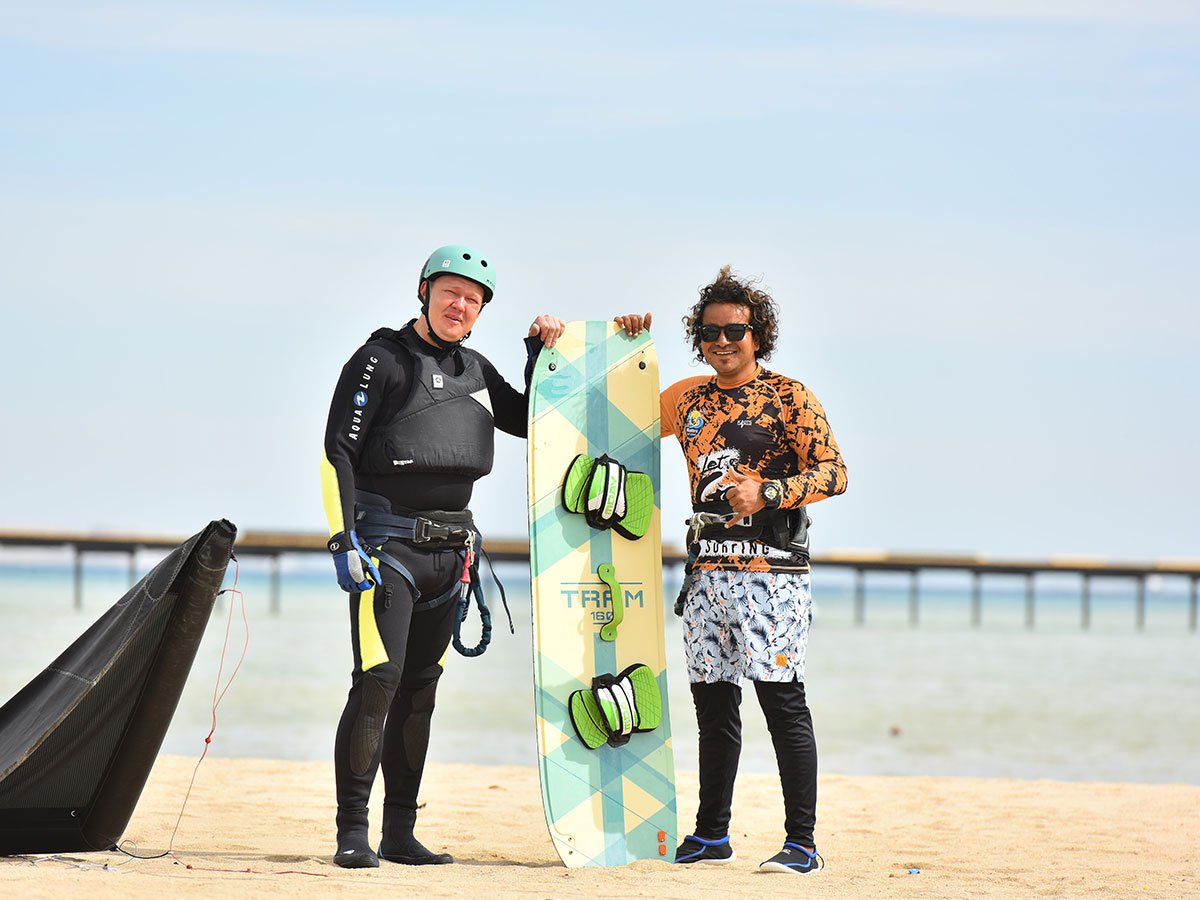
Kitesurfing is moderately hard — harder than getting up on a wakeboard but easier than mastering a windsurfing water‑start — and the difficulty is concentrated in the first 3–6 hours of kite control rather than the board‑riding phase.
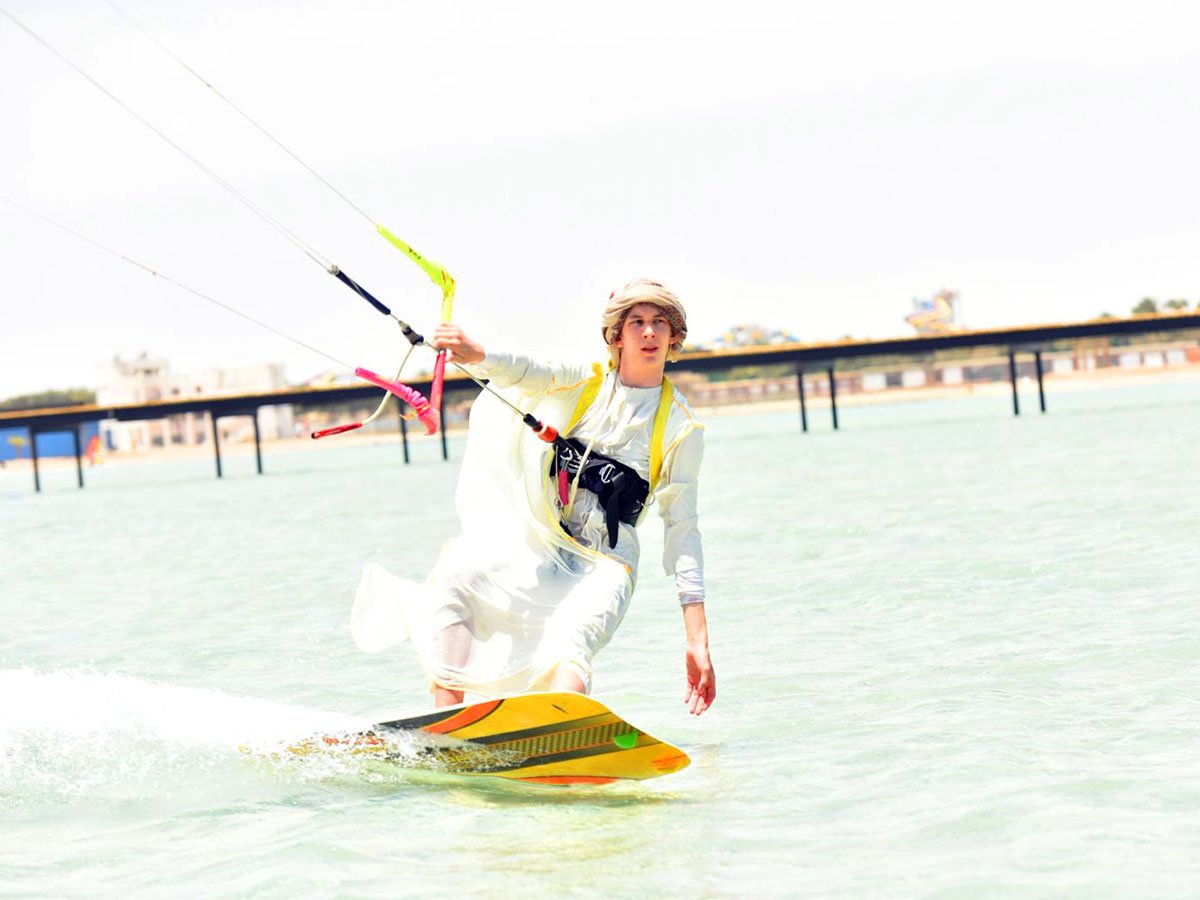
Kitesurfing combines two separate skill sets: flying a controllable power kite and riding a board. Learning either in isolation is straightforward. Learning to coordinate both simultaneously while standing in water and managing wind shifts is where the challenge lies. Most teaching systems therefore split training into distinct stages: kite control on land → body dragging in water (no board) → water‑start with board → sustained riding → riding upwind. Each stage builds directly on the previous one, and IKO‑certified instructors are trained to ensure you master one before moving to the next.
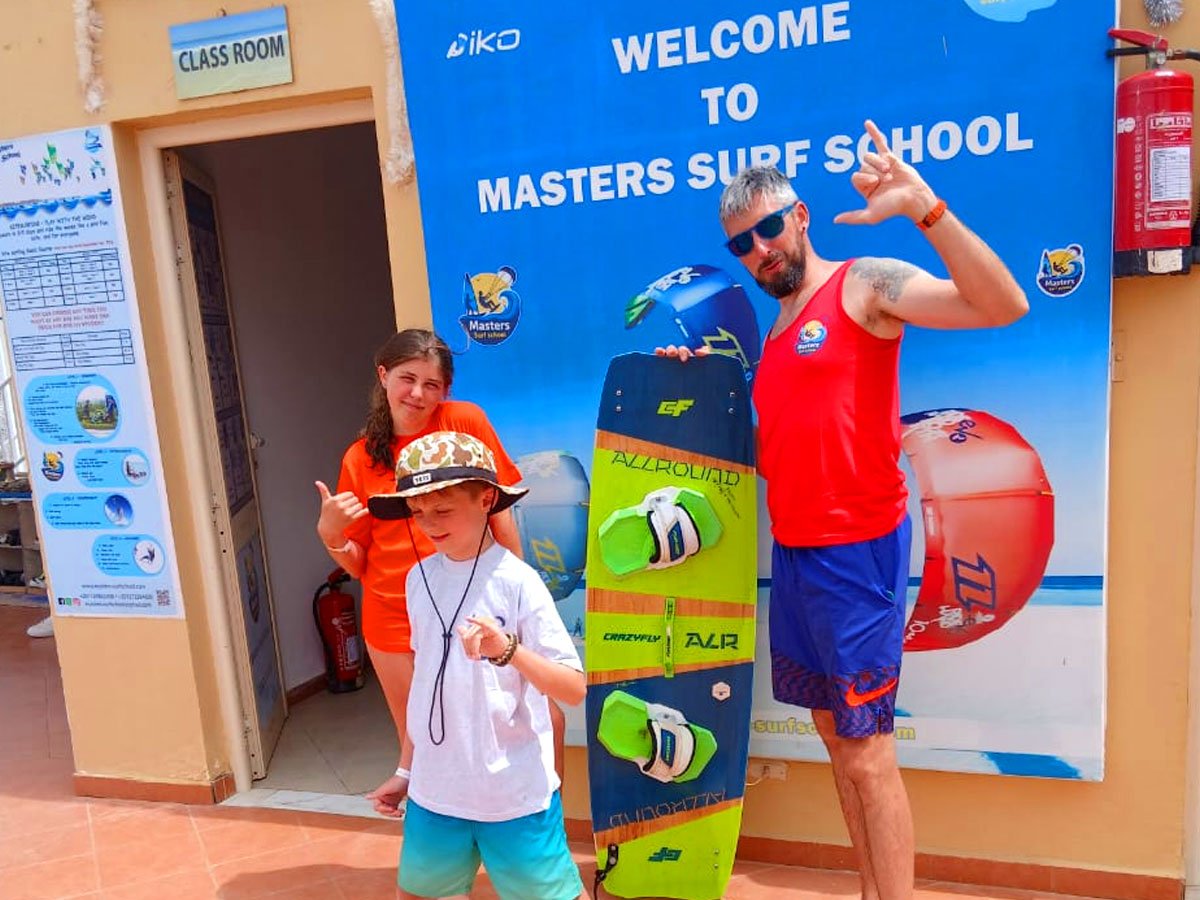
The sport’s reputation for difficulty often stems from people attempting to teach themselves or learning in poor conditions — deep water, strong currents, gusty wind, or overcrowded launch zones. When you learn at a professional centre with the right environment, the perceived difficulty drops sharply.
How Long Does It Take to Learn Kitesurfing?
Most students achieve their first independent water‑starts after 6–12 hours of quality instruction. Becoming a self‑sufficient rider — able to set up gear, launch, ride upwind, and return to the same spot — typically takes 10–20 hours, spread over 3–5 days.

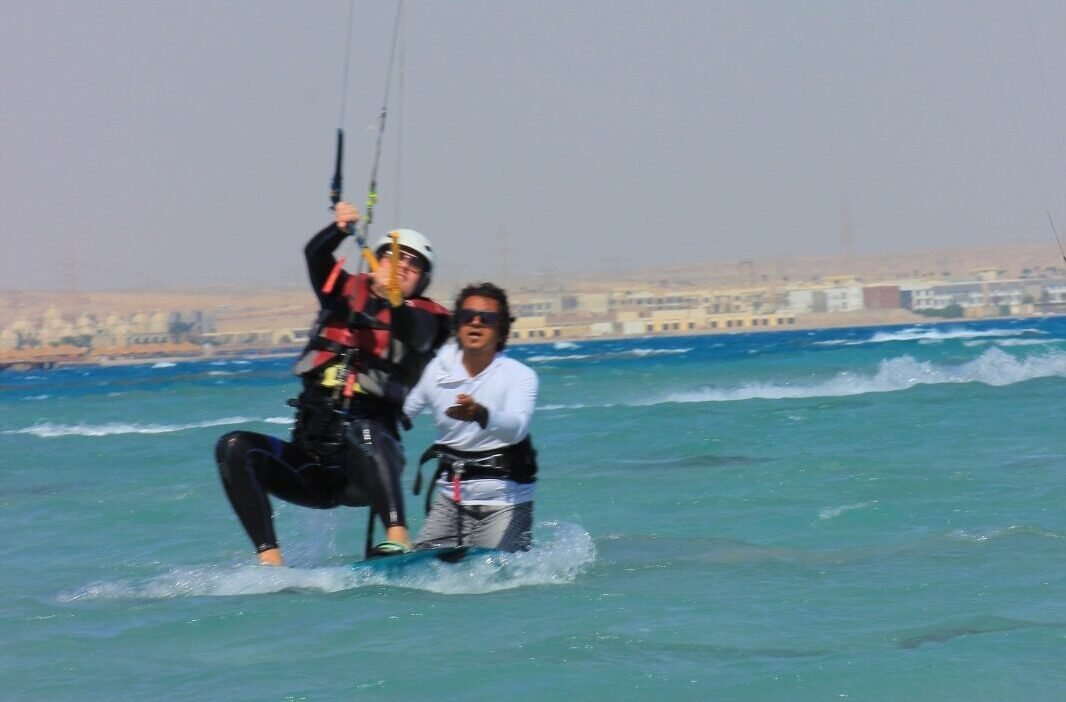
Data from multiple IKO‑affiliated schools consistently shows that private or semi‑private lessons accelerate progress: a one‑on‑one student‑instructor ratio can get a beginner riding in as little as 9 hours (3 days), while group lessons may stretch the same outcome to 12–15 hours. An average student who chooses a private course will learn the basics in roughly 9 hours and begin to ride independently with practice after 15 hours.
The timeline varies based on four factors:
- Prior board‑sport experience (snowboarding, wakeboarding, surfing) helps with balance and board control.
- Kite‑flying background (power kites, traction kites) dramatically shortens the first phase.
- Physical comfort in water — confident swimmers progress faster because they relax during body‑dragging drills.
- Learning environment — a shallow lagoon with steady side‑onshore wind is the single biggest accelerator.
Do You Need to Be Strong or Extremely Fit to Kitesurf?
No. Kitesurfing does not require brute strength. The kite’s pull transfers through a waist or seat harness directly to your core and hips, not your arms. A moderate baseline fitness level — enough to walk in waist‑deep water and sustain light physical activity for 2–3 hours — is sufficient.
Good technique and proper equipment setup matter far more than raw power. Your arms primarily make small steering adjustments on the control bar; they are not load‑bearing. The real physical demands are cardiovascular endurance, core stability, and leg strength for edging the board. Many riders over 40 and children as young as six learn successfully.
That said, a certain level of overall fitness does enhance the experience: stronger legs reduce fatigue during long sessions, a stable core improves balance, and better cardiovascular conditioning lets you recover faster between runs. Recommended complementary exercises include squats, lunges, plank variations, swimming, and cycling.
What Are the Step‑by‑Step Stages of Learning to Kitesurf?
Professional kite schools follow the IKO training path, which progresses through four distinct levels: Discovery (Level 1), Intermediate (Level 2), Independent (Level 3), and Advanced (Level 4). Each level contains specific, measurable competencies.
Level 1 — Discovery (2–4 hours, on land):
- Understand wind theory, the wind window, and site assessment.
- Set up and pack down a 4‑line inflatable kite.
- Use all safety systems: quick‑release, leash, and emergency depower.
- Launch and land the kite with an assistant.
- Fly the kite in the neutral zone with one hand.
Level 2 — Intermediate (6–10 hours, in water):
- Relaunch the kite from the water surface.
- Perform body‑dragging: downwind, crosswind, and upwind (one‑handed).
- Perform a self‑rescue and deep‑water pack‑down.
- Execute the water‑start: dive the kite, place feet in straps, and stand up.
- Ride in both directions with controlled stops.
Level 3 — Independent (10–20 hours total):
- Ride upwind consistently and return to the launch point.
- Perform basic transitions and change of direction.
- Ride toeside.
- Self‑launch and self‑land without assistance.
- Recover the board in deep water.
Level 4 — Advanced (ongoing practice):
- Jump with a grab, perform jump transitions.
- Ride in waves and perform surf‑style turns.
- Execute advanced self‑rescue and pack‑down in deep water.
At a well‑established centre such as Masters Surf School in Hurghada, the semi‑private format (maximum one student per instructor) compresses Levels 1–2 into approximately three days, with many students achieving sustained upwind riding by day five.
What Is the Hardest Part of Kitesurfing for Beginners?
The hardest part is the water‑start — the moment you coordinate a kite dive, board placement, body position, and power delivery all at once to get up and riding. Most learners repeat this step dozens of times before it clicks.
Before the water‑start, students often struggle with kite control: understanding how the kite generates power in different zones of the wind window, and learning to keep the kite stable at 12 o’clock without drifting into the power zone. This is purely a muscle‑memory skill that improves with repetition.
After the water‑start, the next major hurdle is riding upwind. Beginners naturally drift downwind with the kite. Learning to edge the board against the kite’s pull — tilting it on its rail while leaning back — redirects forward momentum into an upwind angle. This skill separates those who walk back up the beach every run from those who become truly independent riders.
Common beginner struggles ranked by reported difficulty:
- Coordinated water‑start (kite + board + body simultaneously)
- Riding upwind consistently
- Relaunching the kite from water
- Maintaining constant kite position without over‑steering
- Overcoming the instinct to pull hard on the bar when nervous
❓ Is Kitesurfing Harder Than Windsurfing?
Kitesurfing has a steeper initial learning curve (the first 6–10 hours) but a much faster path to intermediate proficiency. Windsurfing is easier for the first hour but takes far longer to reach a level where you can plane comfortably and ride in strong wind.
In kitesurfing, once you crack the water‑start, progress accelerates rapidly — you can ride, turn, and start jumping within weeks. In windsurfing, the water‑start itself is a more advanced skill (requiring planing conditions), and most beginners spend many sessions simply uphauling the sail and sailing at low speed.
Key differences:
- Setup complexity: Kitesurfing requires inflating the kite, untangling 20–27 m lines, and performing a careful pre‑flight check. Windsurfing rigging is simpler but physically heavier to carry.
- Physical demand: Windsurfing demands more upper‑body and lower‑back endurance (you hold the sail continuously). Kitesurfing transfers load through the harness, making long sessions less fatiguing.
- Safety: Kitesurfing carries more serious safety risks if procedures are ignored — a kite can loft or drag a rider. Windsurfing risks are generally lower and more localised.
Bottom line: choose kitesurfing if you want faster progression to high‑speed riding and jumping. Choose windsurfing if you prefer a more gradual, technical challenge that rewards precision.
What Are the Most Common Mistakes Beginners Make?
The five most frequent beginner mistakes are: not taking enough professional lessons, using the wrong kite size, skipping safety briefings, looking at the kite instead of where you want to go, and pulling the bar in too hard when panicked.
- Not enough lessons: Many beginners take a single introductory session and then try to practice alone. This is dangerous and inefficient. The IKO recommends a minimum of 9–12 hours of supervised instruction before independent riding.
- Wrong kite size: Being overpowered makes learning far harder. Beginners should err on the side of a slightly smaller kite than the conditions suggest — you can always switch up if underpowered. In Hurghada, a 9 m or 10 m kite suits most 70–85 kg riders in peak season.
- Skipping safety procedures: Not practising the quick‑release before entering the water, or not knowing how to perform a self‑rescue, turns manageable equipment failures into emergencies.
- Looking at the kite, not the riding direction: Your body follows your eyes. Fixating on the kite causes you to lean back too far and stall. Looking toward where you want to ride naturally aligns your posture.
- Pulling the bar in when nervous: The instinctive panic response — pulling the bar hard toward your chest — powers up the kite and worsens the situation. Beginners must learn to sheet out (push the bar away) to depower.
Why Is Kitesurfing in Hurghada Ideal for Beginners?
Hurghada offers a rare combination of a large, shallow, sandy‑bottom lagoon, consistent thermal side‑onshore winds, and a high density of IKO‑certified schools — including Masters Surf School — that together create one of the world’s most forgiving learning environments.
The Al Ahyaa Lagoon area, located just north of Hurghada city centre, provides waist‑deep, warm water (26–30 °C in season) with a sandy bottom. Beginners can stand up at any point, walk back upwind instead of swimming, and focus entirely on kite control without fear of deep water or strong currents. The wind blows side‑onshore, meaning it pushes riders along the coast rather than out to sea — a critical safety feature.
During the peak season (May–October), thermal winds blow 15–25 knots on most days, with a kiteable‑wind probability of approximately 80%. The lagoon’s reef barrier knocks down swell, maintaining flat to light‑chop water even when wind strength increases.
Schools such as Masters Surf School, operating from multiple locations along the Red Sea coast, leverage these conditions with semi‑private IKO‑certified instruction, complimentary hotel transfers, and premium equipment from leading brands. Their structured 12‑hour beginner course takes students from zero to independent riding in as little as three to six days, with all equipment and IKO certification included. The cost of a full beginner course in Hurghada ranges from $300–$500 — roughly half the price of equivalent European destinations.
How Do I Choose a Safe, Quality Kitesurfing School?
Look for three non‑negotiable criteria: IKO certification (verifiable on the IKO website), a teaching location with shallow, flat water and side‑onshore wind, and a student‑to‑instructor ratio of 2:1 or better. Price comes fourth.
IKO‑certified schools meet international standards for instructor qualification, safety protocols, lesson structure, and equipment maintenance. Verify a school’s claim by searching for it on the IKO website under the “Centers” page — be aware that some schools display the IKO logo without holding current affiliation.
The teaching location is equally important. Shallow, sandy‑bottom lagoons with side‑onshore wind (like those in Hurghada) dramatically shorten the learning curve compared to deep‑water or offshore‑wind spots. Avoid schools that launch beginners in deep water or in gusty, offshore conditions.
Semi‑private or private lessons (1:1 or 2:1 ratios) deliver significantly faster progress than group lessons of 3–4 students per instructor. Masters Surf School, for example, runs a maximum of one student per instructor, ensuring personalised attention and faster skill acquisition.
📋 Key Takeaways — Quick Checklist
- ✅ Kitesurfing difficulty is moderate — manageable for anyone with basic fitness and a willingness to learn step by step.
- ✅ Expect 10–20 hours of lessons to become an independent rider; first water‑starts usually happen at 6–12 hours.
- ✅ You do not need exceptional strength — the harness carries the load; core stability and leg endurance matter more.
- ✅ The hardest skill is the coordinated water‑start; the next hurdle is riding upwind consistently.
- ✅ Kitesurfing is harder to start than windsurfing but much easier to master at the intermediate level and beyond.
- ✅ Always learn with an IKO‑certified instructor at a verified school; never attempt to teach yourself.
- ✅ Choose a location with shallow, flat water and side‑onshore wind — kitesurfing in Hurghada at schools like Masters Surf School offers precisely these conditions at roughly half the cost of European spots.
- ✅ Equipment, safety systems, and kite size selection matter enormously — trust your instructor’s guidance on gear.