IKO Certification Levels: Your Complete Guide to Kitesurfing Lessons in Hurghada and Beyond
The International Kiteboarding Organization (IKO) offers the world’s most recognized system for kitesurfing education, with certification levels that span from complete beginner to professional instructor. Whether you’re planning kitesurfing lessons in Hurghada or any other global kitesurfing destination, understanding these certification levels helps you track your progress, choose the right courses, and ensure you’re learning from qualified professionals. The IKO system uses a clear progression from Level 1 (Discovery) through Level 4 (Advanced) for recreational riders, with additional pathways for those who want to become Assistant Instructors, Instructors, or specialized Coaches.
What Are IKO Certification Levels and Why Do They Matter?
IKO certification levels serve as a standardized roadmap for learning kitesurfing safely and effectively. Think of them as your passport to the global kitesurfing community. When you complete a course at an IKO-affiliated school, you receive an IKO Kiteboarder card that documents your achieved level. This card is recognized worldwide, meaning you can continue your education at any IKO center across the globe without repeating what you’ve already mastered.
The system was developed to prioritize safety above all else. Kitesurfing involves powerful forces—kites can generate significant pull, and the wind and water conditions demand respect. IKO’s structured approach ensures that students build skills incrementally, never moving to the next stage until they’ve demonstrated competency in the current one .
For those considering kitesurfing lessons in Hurghada, you’ll find numerous IKO-certified schools operating along the Red Sea coast. These schools follow the same curriculum you’d encounter in Europe, Brazil, or Southeast Asia, giving you confidence that your training meets international standards .
IKO Student Certification Levels: From First Flight to Riding Upwind
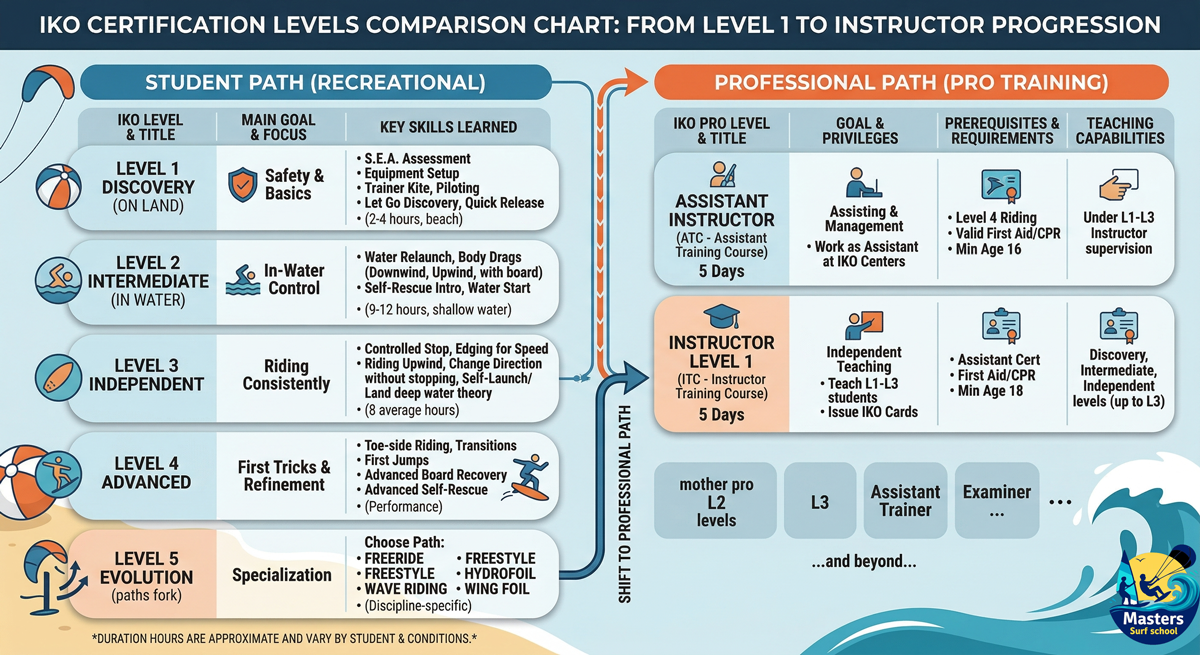
The IKO student pathway is divided into four main levels, each broken into sub-levels that represent specific skills. Most beginners complete Levels 1 and 2 over the course of 9 to 12 hours of instruction, though individual progress varies based on wind conditions, fitness, and aptitude.
Level 1: Discovery – Building Your Foundation
Level 1 introduces you to the kite and its behavior. This stage typically requires 2 to 4 hours and focuses entirely on kite control without the board. Safety systems and proper setup form the backbone of this level.
Level 1A: On Land (20-45 minutes)
Before you touch the water, you’ll learn about wind directions, safe kiting conditions, and how to identify hazards at a launch site. Your instructor will teach you to set up a trainer kite and demonstrate how safety systems work. This theoretical foundation prevents accidents before they happen .
Level 1B: In the Water with Trainer Kite
With a small trainer kite, you’ll develop basic flying skills while standing in shallow water. You’ll practice launching, landing, and understanding the wind window—the three-dimensional space where the kite generates power. Walking and changing directions while flying builds muscle memory.
Level 1C: Four/Five-Line Kite Setup
Now you transition to the full-size inflatable kite you’ll use for riding. You’ll learn to set up a four or five-line kite with a de-power system, perform pre-flight checks, and use international hand signals. Launching and landing with an assistant becomes your new skill .
Level 1D: Hooked-In Flying
You’ll attach your harness and fly the kite while hooked in. This introduces body positioning and the feel of the kite’s power through your core rather than your arms. Advanced flying skills and de-power system mastery are the focus.
Level 1E: Safety First
Pulling the quick release, activating the leash, recovering the bar, and performing a self-landing complete Level 1. These skills ensure you can handle emergencies independently.
Level 2: Intermediate – Getting on the Board
Level 2 takes you into deeper water and onto the board. This stage typically requires 9 to 12 hours and represents the biggest breakthrough moment for most students.
Level 2F: Body Dragging
You’ll learn to enter and exit the water independently while controlling the kite. Water re-launching becomes second nature. Body dragging downwind teaches you how to move without the board, and changing direction while dragging builds control .
Level 2G: Upwind Body Dragging
This critical skill allows you to recover your board when you fall. You’ll practice body dragging upwind to retrieve the board, first without holding it, then while holding it with one hand. Success here means you can retrieve your equipment without assistance.
Level 2H: Water Start Theory
Understanding the power stroke—the movement that generates initial pull—prepares you for the water start. Your instructor will explain safety rules and proper body position before you attempt to stand on the board .
Level 2I: First Rides
The moment you’ve been waiting for arrives. You’ll water start in both directions and ride short distances. Learning to stop controlled completes this sub-level. You’ll also begin understanding weather forecasts, tide effects, and right-of-way rules.
Level 3: Independent – Mastering Control
Level 3 represents true independence on the water. You can now ride in various conditions and handle yourself safely.
Level 3J: Speed Control
Edging—using your board’s edge to control speed—becomes your focus. You’ll learn to ride consistently in both directions with controlled speed.
Level 3K: Upwind Riding
Riding upwind is the skill that separates beginners from independent riders. You’ll learn to ride in all directions, including upwind, while navigating among other water users and respecting right-of-way rules .
Level 3L: Changing Direction
You’ll practice changing direction without stopping—a skill essential for long rides. Self-rescue and full pack-down in the water complete this level, ensuring you can handle equipment failures.
Level 3M: Advanced Launching
Self-launching your kite without assistance marks your progression toward complete independence. Risk assessment and awareness of riding areas round out this sub-level .
Level 4: Advanced – Ready for Anything
The Level 4 riders possess the skills to ride in varied conditions and begin exploring specialized disciplines.
Level 3N: Toe Side and Basic Jumps
Toe side riding and understanding jumping theory prepare you for more advanced maneuvers. Landing a basic jump safely represents the culmination of the recreational pathway .
At Level 4, you can ride upwind consistently, perform self-rescue in deep water, self-launch and self-land, and ride in crowded areas safely. This level also qualifies you to pursue professional instructor training.
Comparison Table: IKO Student Levels at a Glance
| Level | Duration | Key Skills | Certification Awarded |
|---|---|---|---|
| Level 1 | 2-4 hours | Kite setup, safety systems, basic flying, body dragging | IKO Kiteboarder Level 1 |
| Level 2 | 9-12 hours | Water starts, short rides, board recovery, upwind body drag | IKO Kiteboarder Level 2 |
| Level 3 | 6-10 hours | Edging, upwind riding, direction changes, self-rescue | IKO Kiteboarder Level 3 |
| Level 4 | 5-8 hours | Toe side riding, basic jumps, self-launch | IKO Kiteboarder Level 4 |
Professional IKO Certifications: Becoming an Instructor
For those who want to turn their passion into a profession, IKO offers a structured instructor pathway. This is where the term “IKO certification levels” expands beyond student ratings into professional qualifications.
Assistant Training Course (ATC)
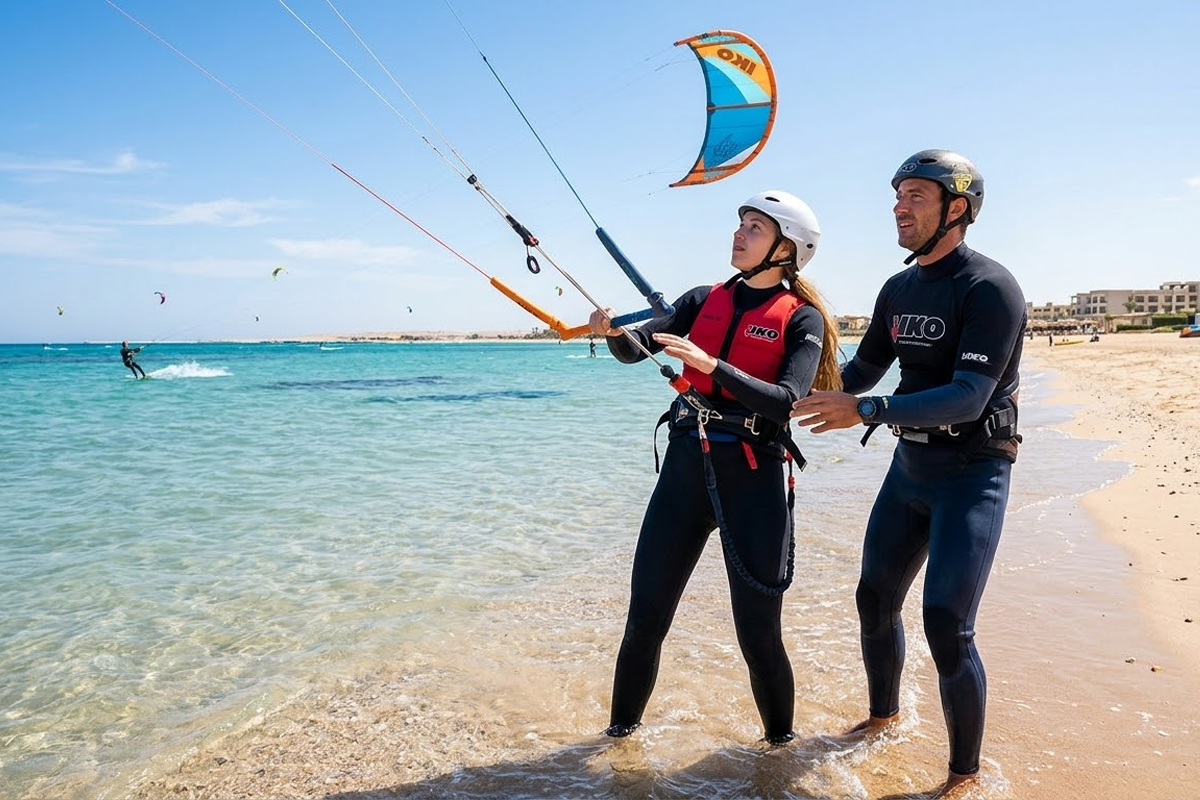
The ATC serves as your entry point into professional kitesurfing. This five-day course combines e-learning with in-person training at an IKO Center. You’ll learn teaching methodology, safety protocols, and how to assist a lead instructor.
Prerequisites for ATC:
- Minimum age 16 years
- IKO Kiteboarder Level 4 Advanced or equivalent skills
- Valid First Aid and CPR certification (in-person training, online not accepted)
What the ATC Covers:
The course includes Module 1 (eLearning) covering kitesurfing theory, weather, equipment knowledge, and safety principles. Module 2 consists of five days of in-person training covering practical safety skills, assisting with student lessons, launch and landing procedures, and beach management .
ATC Cost and Duration:
The ATC typically costs around $765 including the IKO Module 1 fee of $199. The course runs for five days with up to eight students per organizer .
Instructor Training Course (ITC)
Once you’ve completed your ATC and gained experience as an assistant, you can progress to the ITC. This five-day professional course transforms you into a fully certified IKO Instructor.
Prerequisites for ITC:
- Minimum age 18 years
- IKO Assistant Certification (ATC completed)
- Valid First Aid Certificate (within 2 years)
- IKO Level 4 Advanced skills demonstrated via video or in-person
- Skills include: jump with grab, ride toeside upwind, deep water board recovery, self-rescue, self-launch and self-land
What the ITC Covers:
Teaching methodology takes center stage, including lesson structure, psychology of teaching, and progression management. Safety mastery covers risk assessment and emergency protocols. Practical skills include demonstration techniques, student analysis, and real teaching practice with actual students .
Assessment Requirements:
You’ll need to pass a written exam (minimum 15 out of 20) and demonstrate practical teaching and riding skills .
ITC Cost:
The ITC costs approximately $1,142 including the IKO Module 1 fee of $329 .
Instructor Level 2 and Level 3
After working as a Level 1 Instructor, you can advance through additional certifications.
Instructor Level 2:
To qualify for Level 2, you must have logged at least 35 students and 280 teaching hours. Once these requirements are met, you can apply for the online exam and enroll in the Level 2 course. Level 2 Instructors can run Evolution Clinics, teach courses with multiple students, and lead IKO Adventures with more participants .
Instructor Level 3 and Coach Trainer:
Higher levels require extensive experience and demonstration of elite riding skills. Coach Trainers must be Level 2 Instructors who have run at least four Evolution Clinics or certified 40 Level 5 students. They must also be at least 24 years old and validated for all Evolution discipline skills .
The New Coach Certification: Specializing in Advanced Riding
In 2022, IKO introduced the Coach Level 1 certification—a fully online program designed for instructors who want to specialize in advanced riding disciplines .
Why Coach Certification Was Created:
The Coach program addresses two needs: kiters who want to progress beyond Level 4, and instructors who want to differentiate themselves by teaching advanced students. IKO recognized that teaching advanced riders requires different approaches than teaching beginners .
Evolution Disciplines:
Coach certification is available in five Evolution disciplines:
- Freeride
- Freestyle
- Wave Riding
- Hydrofoil
- Wing Foil
Prerequisites for Coach Level 1:
- IKO Level 1 Instructor or higher with active membership
- Ability to perform safety procedures (self-rescue, self-launch, self-land)
- Ability to perform required maneuvers in at least one Evolution discipline
How Certification Works:
Candidates must submit video demonstrating their riding skills for each discipline they want to coach. The video must show Level 4 and Level 5 skills, including safety procedures. Once approved, candidates complete an online exam. The certification costs $150 for the first discipline, with additional disciplines included at no extra charge .
What Coaches Can Do:
- Teach one student at a time in advanced disciplines
- Certify kiters up to Level 5 Evolution
- Lead IKO Adventures (with Freeride Coach certification) including downwinders, boat trips, and kite safaris
Kitesurfing Lessons in Hurghada: What to Expect
Hurghada has established itself as one of the world’s premier kitesurfing destinations, and the IKO certification system is deeply embedded in the local kitesurfing culture.
Why Hurghada for Kitesurfing Lessons
The Red Sea offers ideal conditions for learning. Shallow, flat-water lagoons provide safe, controlled environments where students can stand and practice without worrying about waves or strong currents. The wind blows consistently year-round, with speeds typically ranging from 10 to 40 knots .
Water Conditions:
The shallow lagoons near Hurghada extend for hundreds of meters, allowing beginners to walk rather than swim when retrieving gear. This dramatically reduces the physical demands of learning and lets students focus on kite control .
Seasonal Wind Patterns:
The kitesurfing season runs year-round, with peak winds during summer months. Winter offers milder conditions ideal for beginners, while experienced riders enjoy stronger thermal winds in summer.
IKO Schools in Hurghada
Several IKO-affiliated schools operate in Hurghada and the nearby resort town of El Gouna. These schools maintain modern equipment and employ certified instructors.
Kitepower El Gouna PRO:
This IKO center offers structured packages for beginners: 2-hour intro, 8-hour beginner, 11-hour intermediate, and 15-hour intermediate-advance packages. They also offer refresh packages for advanced riders seeking 3, 6, or 9-hour coaching sessions. The school operates with head instructor Lukas Vogeltanz, an international team rider with years of daily teaching experience .
Kite School Egypt:
Located in Hurghada, this school has earned consistent positive reviews for its patient instruction and professional approach. Students report rapid progression, with many completing the 6-day intensive course to ride independently within a week. The school offers radio-assisted instruction and maintains a low student-to-instructor ratio .
What Kitesurfing Lessons in Hurghada Include
Standard lesson packages typically include:
- 2-3 hours of instruction per session
- All equipment (kites, boards, harnesses, helmets, impact vests)
- Radio communication with your instructor
- IKO certification upon completion
- Hotel transfers (within reasonable distance)
Typical Pricing:
Beginner packages in Hurghada range from $200 for a 4-hour introduction to $600-800 for complete 12-hour courses that bring students to independent riding level.
Student Experiences
Reviews consistently highlight the quality of instruction in Hurghada. One student who completed a 6-day intensive course reported: “With no previous experience, I’ve been able to ride by myself quite quickly” . Others note the patience of instructors and the supportive community atmosphere at local schools.
IKO Certification Costs: What You’ll Pay
Understanding the costs associated with IKO certification helps you budget for your kitesurfing journey.
Student Certification Costs
Student lessons vary widely by location, but typical costs for complete beginner-to-independent training:
- 2-hour intro session: $100-150
- 9-12 hour complete beginner package: $500-800
- Hourly rates for advanced coaching: $60-100 per hour
Professional Certification Costs
| Certification | Duration | IKO Module Fee | Total Cost |
|---|---|---|---|
| Assistant (ATC) | 5 days | $199 | $765 |
| Instructor (ITC) | 5 days | $329 | $1,142 |
| Coach Level 1 | Online | $150 | $150 (first discipline) |
| Level 2 Instructor | Variable | Included in course | Varies by organizer |
Note that these costs do not include travel, accommodation, or equipment (unless rented from the school). First Aid certification adds approximately $100-200 depending on location .
Maintaining Your IKO Certification
IKO certifications require annual renewal to remain valid. The membership includes professional and recreational liability insurance, which is essential for working instructors. Renewal costs are typically modest compared to initial certification fees .
For Instructors:
- Renew membership annually
- Maintain valid First Aid/CPR certification (renew every 2 years)
- Log teaching hours and student certifications through your IKO profile
For Students:
- Your IKO Kiteboarder card remains valid indefinitely
- To continue lessons after a break, most schools will assess your current level rather than starting over
Step-by-Step Checklist: Your Path Through IKO Certification
Use this practical checklist to navigate your kitesurfing education journey:
For Recreational Riders
- Choose an IKO school with certified instructors and good reviews
- Book Level 1 lessons (2-4 hours) to master kite control and safety
- Complete Level 2 (9-12 hours) to achieve water starts and short rides
- Practice body dragging until you can recover your board reliably
- Progress to Level 3 to learn upwind riding and self-rescue
- Achieve Level 4 for advanced skills and instructor eligibility
Aspiring Instructors
- Master Level 4 riding skills including jumps, toe side, and self-launch
- Obtain valid First Aid/CPR certification (in-person course, not online)
- Complete ATC eLearning Module 1 before traveling to your course
- Attend 5-day ATC in-person training at an IKO Center
- Work as an Assistant Instructor to gain experience
- Complete Pre-ITC requirements and online preparation
- Attend 5-day ITC and pass written and practical exams
- Log students and hours toward Level 2 qualification
For Advanced Instructors Seeking Coach Certification
- Ensure active IKO Instructor membership
- Select your Evolution discipline (Freeride, Freestyle, Wave, Hydrofoil, Wing)
- Film yourself performing required maneuvers with safety skills
- Upload videos for evaluation by IKO Training Department
- Complete online exam after skill approval
- Add additional disciplines at no extra cost
Frequently Asked Questions
Most students complete Levels 1 through 3 in 12-20 hours of instruction spread over 3-7 days. Reaching Level 4 typically requires additional 5-10 hours of practice and coaching. Individual progress varies based on wind conditions, physical fitness, and learning aptitude.
Absolutely. Hurghada’s shallow lagoons make it one of the best places in the world for complete beginners. Schools start with trainer kites on the beach before progressing to water, ensuring you build skills safely .
Yes. IKO is the largest and most recognized kitesurfing certification organization globally. Your IKO Kiteboarder card is accepted at affiliated schools in over 60 countries, allowing you to continue lessons wherever you travel .
Level 4 is a student certification indicating advanced riding skills. Coach certification is a professional qualification for instructors who want to specialize in teaching advanced disciplines like freestyle, wave riding, or hydrofoil .
For student lessons, equipment is always provided. For professional courses (ATC, ITC), you typically need your own kite, bar, board, harness, helmet, and impact vest, though some schools offer rentals .
Beginner packages range from $500-800 for complete courses that bring you to independent riding. Hourly advanced coaching runs $60-100. These rates typically include all equipment and IKO certification fees.
No. IKO requires in-person First Aid and CPR training with hands-on practice using mannequins. Online certificates are not accepted .
Your IKO instructor diploma is valid for one year and must be renewed annually with membership fees. First Aid certification must be renewed every two years .
IKO certification levels Conclusion
IKO certification levels provide a clear, structured pathway for anyone who wants to learn kitesurfing or turn their passion into a profession. From the first moment you fly a trainer kite on the beach to the day you certify as an instructor, the IKO system ensures you build skills methodically with safety as the foundation.
For those considering kitesurfing lessons in Hurghada, you’ll find ideal learning conditions combined with experienced IKO-certified instructors. The Red Sea’s shallow lagoons, consistent winds, and professional schools make it one of the world’s most reliable destinations for progressing through your certification levels.
Whether your goal is to ride independently on vacation or to build a career as a kitesurfing instructor, understanding the IKO certification system helps you make informed decisions about your training. Choose an IKO school, commit to the structured progression, and you’ll join a global community of kiters who share the same language of safety, skills, and passion for the sport.

[…] International Kitesurfing Organization (IKO) sets global standards for instruction. IKO-certified schools follow structured teaching […]
[…] should only learn from internationally certified (IKO) instructors. The International Kiteboarding Organization sets the global standard for safety […]
[…] Kitesports Association (BKSA) on programs like kitefoil racing, but the actual instruction and certification come from IKO or BKSA, not RYA. Therefore, for kitesurfing, IKO is the direct answer to the RYA vs IKO […]
[…] for beginners. All these schools use IKO teaching methods and issue internationally recognized IKO certificates upon course […]
[…] over 25 years of expertise, Masters Surf School provides IKO-certified instruction, top-quality equipment, and complimentary hotel transfers. Prices for beginner courses […]
[…] International Kiteboarding Organization (IKO) structures learning into three […]
[…] Titanic Hotel is the answer. While other camps offer solid options, Masters uniquely combines an IKO-certified curriculum, a dedicated shallow-water lagoon directly on-site, and a staggering 25 years of local […]
[…] IKO Certification: Look for an IKO (International Kiteboarding Organization) certified school. This guarantees instructors follow strict safety protocols, including “site assessment, safety systems, and weather theory.” […]
[…] of the water. A hurghada kitesurfing Course will provide you with an internationally recognized IKO certification card at the end, which acts as your “kitesurfing license” to rent equipment and prove […]