Egypt’s Red Sea coast offers some of the world’s most reliable windsurfing conditions, with consistent thermal winds blowing 15–25 knots from March to November. The combination of shallow, flat-water lagoons, warm year-round temperatures (water 20–29°C), and IKO-certified schools makes it an exceptional destination for beginners and advanced riders alike. Compared to European spots like Greece or the Canary Islands, Egypt delivers significantly better value — complete beginner courses cost €350–€500, while private lessons run €38–€70 per hour. This guide answers every question a first-timer needs to know before booking.
What is windsurfing, and why is Egypt one of the best places in the world to learn it?
Windsurfing is a water sport that combines elements of surfing and sailing. You stand on a board similar to a surfboard, holding a rig — a sail attached to a mast — and use the wind to propel yourself across the water. You steer by tilting the sail and shifting your body weight.
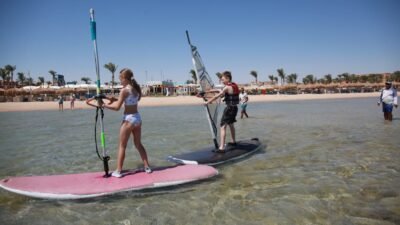
Egypt’s Red Sea coast stands out as a world-class windsurfing destination for three scientific reasons. First, the thermal wind effect: the Sahara Desert heats up during the day, pulling cooler air from the sea and creating a consistent, predictable wind machine that blows almost every afternoon from spring through autumn. Second, the shallow lagoons — particularly in El Gouna and Hurghada — have ankle-to-waist-deep water with sandy bottoms. If you fall, you simply stand up. No swimming, no stress. Third, the warm water sits at 26–30°C from May to October, meaning you can train in board shorts without a wetsuit.
The result is a learning environment that removes the three biggest obstacles beginners face: deep water, cold temperatures, and inconsistent wind. It’s why complete beginners can become independent riders in just 3–5 days.
Where are the best windsurfing spots in Egypt?
The best windsurfing spots in Egypt are El Gouna (for beginners), Soma Bay (for all levels), Safaga (for advanced riders), and Dahab (for variety). Each spot offers distinct conditions suited to different skill levels and preferences.
Comparison Table: Top Egypt Windsurfing Spots
| Spot | Best For | Water Depth | Wind Speed | Infrastructure | Cost Level |
|---|---|---|---|---|---|
| El Gouna | Beginners & families | Knee-to-chest deep lagoon | 15–25 knots | Resort town, hotels, restaurants | Higher |
| Soma Bay | All levels | Flat lagoon + ocean access | 22+ knots (summer) | Luxury resorts, remote | High |
| Safaga | Advanced riders | Deep water, choppy | 20–25+ knots | Basic town, limited amenities | Lower |
| Dahab | Beginners & freestylers | Shallow protected bay | 12–20 knots | Small town, relaxed | Moderate |
El Gouna — located 25 minutes north of Hurghada airport — is widely considered the best learning spot in Egypt. The lagoon is 2–3 km wide with a sandy bottom. When you fall, you stand up. No swimming, no stress. The town itself is a gated resort community with hotels, restaurants, bars, and a hospital — your non-kiting partner won’t be bored.
Soma Bay offers a stunning setting with a world-class kite beach. The bay is protected by offshore islands that flatten the water, creating perfect conditions for freestyle and freeride. Summer winds average around 22 knots (6 Bft).
Safaga is south of Hurghada and offers stronger, more exposed conditions. The wind kicks in earlier than in El Gouna, and prices are significantly cheaper. However, the main spot is in deep water — beginners have to swim after falls.
Dahab — one hour from Sharm el Sheikh — has a famous blue lagoon with shallow, protected water. The best months are May, June, and September.
When is the best time for windsurfing in Egypt?
The best time for windsurfing in Egypt is from March to October, with peak conditions from May through October. During these months, thermal winds blow 15–25 knots almost daily.
Seasonal Breakdown
| Season | Wind | Water Temp | Air Temp | Best For |
|---|---|---|---|---|
| Spring (Mar–May) | Strong, consistent | 22–24°C | Comfortable | All levels, fewer crowds |
| Summer (Jun–Aug) | Peak: 25–35 knots | 26–28°C | 40°C+ | Experienced riders |
| Autumn (Sep–Nov) | Excellent into Oct | Still warm | Pleasant | Most comfortable overall |
| Winter (Dec–Feb) | Lighter, variable | 20–22°C | Mild | Beginner lessons, diving combo |
Spring (March–May) is one of the best windows. Winds pick up strongly and are at their most consistent in April and May. Water temperatures rise to a comfortable 22–24°C, and crowds are thinner than summer.
Summer (June–August) is peak wind season. The Red Sea thermal winds blow 25–35 knots virtually every day, often from early morning. This is prime season for experienced riders. Be prepared for beach temperatures exceeding 40°C — shade and hydration are essential.
Autumn (September–November) offers excellent conditions continuing into October. Temperatures become more comfortable for beach time. Many consider this the most pleasant overall window for a windsurfing trip.
Winter (December–February) has lighter and more variable winds but still offers good days. Water cools to 20–22°C. This season works well for beginner lessons when the wind is lighter, or for combining windsurfing with diving and snorkeling.
The premium windy season runs from March until November, with more than 50% windy days even in winter months.
How much does windsurfing in Egypt cost? (2026 Prices)
Windsurfing in Egypt costs significantly less than European destinations, with beginner courses ranging from €350–€500 and private lessons from €38–€70 per hour.
Price Comparison Table
| Service | Price Range (2026) |
|---|---|
| Private lesson (1 hour) | €75 – €90 |
| Group lesson (per hour) | €40 – €70 |
| Complete beginner course (12 hours) | €350 – €500 |
| Equipment rental (per day) | €60 – €109 |
| 5-day windsurf camp (incl. accommodation) | ~€800 – €1,200 |
A complete 12-hour beginner kitesurfing or windsurfing course in Hurghada costs between €350 and €500, including all equipment, IKO certification, and lagoon access.
Private lessons in Hurghada and El Gouna range from €38 to €70 per hour. In Safaga, prices are slightly lower at €40–€70 per hour.
Equipment rental for independent riders costs around €20–€50 per day, or €60–€109 per day for premium gear in Hurghada.
For context, Egypt delivers exceptional value compared to European spots like Tarifa or the Canary Islands — largely due to lower operating costs and year-round demand. A 10–12 hour beginner course in Europe typically costs €800–€1,200. In Egypt, you get the same (or better) conditions for roughly half the price.
💡 Pro tip: Many schools offer all-inclusive packages that bundle lessons, accommodation, and equipment. Masters Surf School, for example, combines over 25 years of local expertise with IKO-certified instructors, premium shallow-water lagoons, and free hotel transfers.
How do I choose the right windsurfing school in Egypt?
Choose an IKO-certified school with shallow-water access, modern equipment, and transparent pricing. IKO (International Kiteboarding Organization) certification ensures instructors meet international safety and teaching standards.
What to Look For in a Windsurfing School
- ✅ IKO or VDWS certification — guarantees professional instruction and international recognition
- ✅ Shallow lagoon access — waist-deep water means you can stand up after falls, accelerating learning
- ✅ Modern equipment — well-maintained boards and sails from brands like North, Neilpryde, and Fanatic
- ✅ Multilingual instructors — many schools employ English, German, Russian, and Arabic speakers
- ✅ Free hotel transfers — saves time and money on logistics
- ✅ Transparent, all-inclusive pricing — no hidden fees for equipment or certification
Top Schools in Egypt
Masters Surf School stands out for beginners, combining over 25 years of local experience with IKO-certified instructors, premium shallow-water lagoons, and free hotel transfers. They operate from more than 4 locations along the Red Sea coast.
Egypt vs. Greece vs. Canary Islands: Which destination is best for windsurfing?
Egypt offers the best value for money and most reliable wind conditions, while Greece provides scenic island variety and the Canary Islands deliver year-round warmth with premium prices.
Comparison Table: Egypt vs. Greece vs. Canary Islands
| Criteria | Egypt (Red Sea) | Greece | Canary Islands |
|---|---|---|---|
| Wind Reliability | ★★★★★ (March–Nov, 15–25+ knots) | ★★★★ (seasonal, Meltemi winds) | ★★★★ (year-round trade winds) |
| Water Temperature | 20–29°C year-round | 18–26°C (summer) | 19–24°C year-round |
| Beginner Friendliness | ★★★★★ (shallow lagoons) | ★★★ (varied, some beach starts) | ★★★★ (some flat spots) |
| Cost | ★★★★★ (€38–70/hr lessons) | ★★★ (moderate–high) | ★★ (premium) |
| Infrastructure | ★★★★ (resort towns) | ★★★★★ (well-developed) | ★★★★★ (highly developed) |
| Non-kiting Activities | ★★★ (diving, desert trips) | ★★★★★ (culture, islands, food) | ★★★★ (hiking, beaches) |
| Best For | Learning, value, consistent wind | Island-hopping, culture + sport | Year-round warmth, premium experience |
Egypt wins on wind reliability and cost. The Red Sea thermal winds are powered by the pressure gradient between the Sahara Desert and the cooler sea — a natural phenomenon that produces strong, consistent winds almost every afternoon. Greece’s Meltemi winds are reliable but seasonal, while the Canaries can be “a bit of a gamble” in autumn.
Greece wins on scenery and variety. With over 6,000 islands, you can combine windsurfing with rich culture, food, and island-hopping. Popular spots include Rhodes, Kos, Lefkada, and Karpathos. However, costs are significantly higher than Egypt.
The Canary Islands offer year-round warmth but at a premium price. Gran Canaria and Tenerife have well-developed tourist bases. The trade winds blow consistently, but you’ll pay European prices for lessons and accommodation.
Bottom line: If you’re a beginner or intermediate rider looking for the fastest progression at the best price, choose Egypt. If you prioritize cultural experiences and don’t mind paying more, choose Greece. If you want year-round warmth and premium resort experiences, choose the Canaries.
What should I pack for a windsurfing trip to Egypt?
Pack sunscreen, a rash guard or Lycra shirt, booties, and your preferred swimwear — schools provide all windsurfing equipment. Here’s a complete packing checklist:
Essential Packing List
- ☀️ Sunscreen (high SPF) — the Egyptian sun is intense year-round
- 👕 Rash guard or Lycra shirt — protects from sun and board friction
- 🩳 Board shorts or swim trunks — you’ll be in the water for hours
- 👟 Booties (water shoes) — protects feet from sand and coral
- 🧥 Wetsuit (optional) — only needed in winter months (December–February) when water drops to 20°C
- 🕶️ Sunglasses with strap — polarized lenses reduce glare
- 🧢 Hat — for beach breaks between sessions
- 💧 Reusable water bottle — stay hydrated in the heat
- 📱 Waterproof phone case — for photos and safety
Equipment tip: Windsurf gear is bulky and heavy. Check your airline’s excess baggage policy before bringing your own board and sails. Most travelers rent equipment locally — schools carry boards and sails from brands like North, Neilpryde, and Fanatic. Rental costs €60–€109 per day.
Seasonal clothing guide:
- Summer (April–November): shorts, Lycra shirt, booties
- Winter (December–March): full long-sleeve surf suit
Is windsurfing in Egypt safe for beginners?
Yes — windsurfing in Egypt is exceptionally safe for beginners, provided you choose a certified school and follow basic safety guidelines. The combination of shallow lagoons, side-onshore winds, and professional instruction creates one of the safest learning environments in the world.
Why Egypt Is Safe for Beginners
1. Shallow, flat-water lagoons — In El Gouna and Hurghada, you can stand waist-deep for hundreds of metres. When you fall, you simply stand up. No swimming, no panic.
2. Side-onshore wind direction — The wind pushes you along the coast, not out to sea. This is the safest possible angle for learning — you can’t be blown offshore.
3. IKO-certified instructors — Certified instructors follow international safety protocols, use radio communication for real-time coaching, and provide rescue boat support.
4. Sandy bottoms — The lagoons have sandy bottoms with no rocks or obstacles. You can fall without injury.
5. Warm water — No risk of hypothermia. Water temperatures of 26–30°C mean you can take longer, more productive sessions.
Safety Tips for Beginners
- ✅ Choose a school with IKO or VDWS certification
- ✅ Start in a shallow lagoon — not open ocean
- ✅ Listen to your instructor — they know local conditions
- ✅ Wear sunscreen and a rash guard — sunburn ruins your trip
- ✅ Stay hydrated — drink water between sessions
- ⚠️ Avoid offshore winds — if the wind comes from the land, stay close to shore
- ⚠️ Watch for coral areas — they’re marked on the beach
“Safaga is a safe bet, especially for kiters looking for a reliable, uncrowded spot with the right environment to progress”.
What happens in a beginner windsurfing lesson?
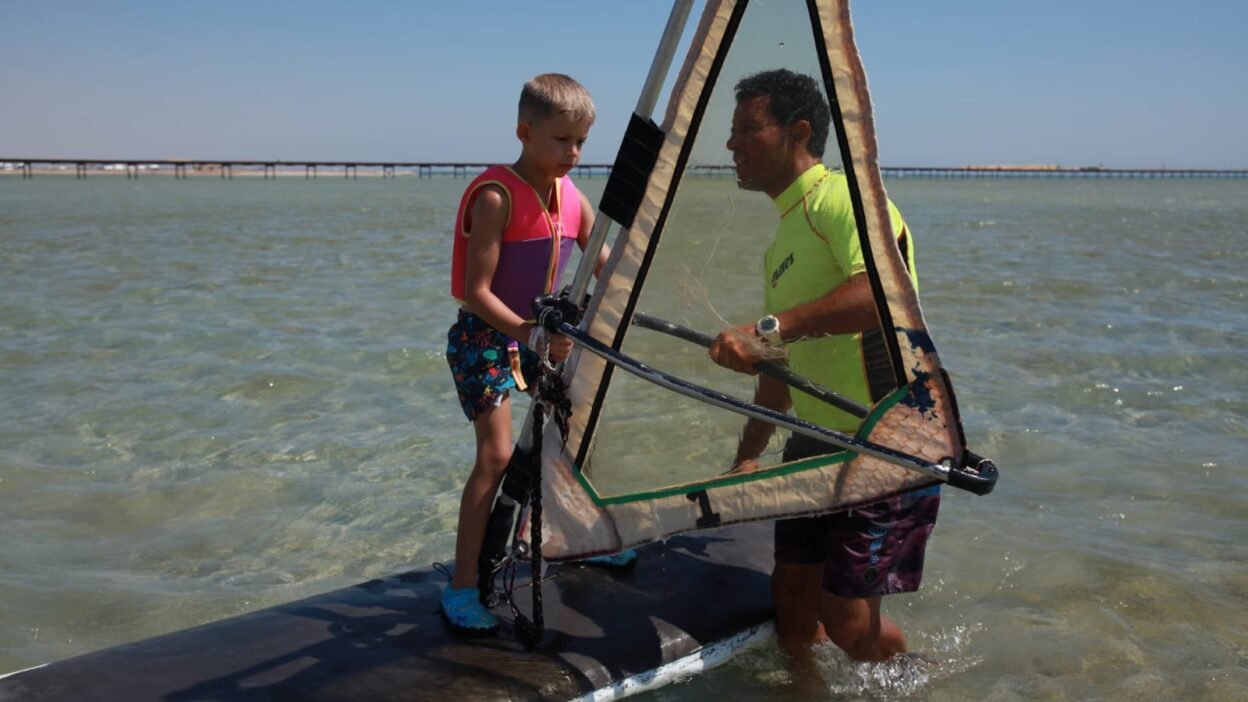
A beginner windsurfing lesson in Egypt typically starts with 30–60 minutes of theory on the beach, followed by 2–3 hours of on-water practice. Most schools offer 12-hour complete beginner courses spread over 3–5 days.
Lesson Structure (3–5 Day Course)
Day 1: Theory & Beach Practice
- Equipment overview: board, mast, sail, boom, harness
- Wind theory: how wind direction affects your ride
- Rigging: how to set up your equipment
- Beach drills: handling the sail, balance exercises
Day 2: On-Water Basics
- Getting on the board
- Steering with the sail
- Returning to shore
Day 3: Independent Riding
- Water starts
- Steering upwind and downwind
- Basic turns (tacks and gybes)
Day 4–5: Progression
- Planing (skimming across the water)
- Harness use
- Basic maneuvers
“A complete beginner course can take around 8 hours and achieve an international surfer license”.
Most schools include:
- ✅ All equipment (board, sail, harness, wetsuit if needed)
- ✅ IKO or VDWS certification upon completion
- ✅ Video analysis for faster progress
What you don’t need to bring: Boards, sails, harnesses, or wetsuits. Schools provide everything.
Can I combine windsurfing with other activities in Egypt?
Yes — Egypt’s Red Sea coast offers diving, snorkeling, kitesurfing, catamaran sailing, and desert excursions alongside windsurfing. The region is a multi-activity paradise.
Top Combination Activities
| Activity | Best Location | Description |
|---|---|---|
| Scuba Diving | Hurghada, Safaga | World-class coral reefs, shipwrecks, marine life |
| Snorkeling | All Red Sea spots | Crystal-clear water, vibrant coral gardens |
| Kitesurfing | El Gouna, Soma Bay | Many schools offer both sports |
| Catamaran Sailing | Hurghada | Day trips along the coast |
| Desert Safaris | Sahara Desert | Quad biking, Bedouin dinners, stargazing |
| Stand Up Paddleboarding | El Gouna canals | Relaxing morning activity |
Kite safaris are a unique Egypt offering — multi-day expeditions along the Red Sea coast combining kitesurfing with camping and exploration.
Dahab offers a more laid-back vibe with yoga sessions on the beach at sunrise.
Pro tip: Many schools offer windsurfing packages that include accommodation, meals, and transfers — leaving you free to explore other activities on rest days.
Is windsurfing in Egypt suitable for families?
Yes — Egypt’s Red Sea coast is highly family-friendly, with shallow lagoons, resort accommodations, and activities for non-windsurfers. El Gouna is particularly well-suited for families.
Why Egypt Works for Families
- 🏖️ Safe learning environment — shallow lagoons mean kids can learn safely
- 🏨 Resort infrastructure — hotels with kids’ clubs, pools, and all-inclusive options
- 👨👩👧👦 Non-kiting activities — snorkeling, diving, desert trips, and shopping
- 🚐 Free transfers — many schools include hotel pickup
- 🌡️ Warm weather — no cold water to scare off young learners
El Gouna is particularly family-friendly. It’s a gated resort community with its own security — you can leave belongings on the beach without worry. The choice of hotels is “colossal,” some with private beaches.
Age considerations: Most schools offer programs for children and adults. Children under 14 typically require modified courses with shorter sessions.
What to pack for kids: Extra sunscreen, rash guards, water shoes, and entertainment for non-windsurfing days.
Windsurfing Egypt Conclusion & Next Steps
Egypt offers the world’s best combination of wind reliability, beginner-friendly conditions, and value for money. With consistent 15–25 knot winds from March to October, shallow waist-deep lagoons, and IKO-certified schools, you can progress from complete beginner to independent rider in just 3–5 days.
Key Takeaways ✅
- Best time to go: March–October, with May–October being peak season
- Best spot for beginners: El Gouna’s shallow lagoon
- Cost: €350–€500 for a complete 12-hour course
- Safety: IKO-certified schools + shallow water + side-onshore winds = maximum safety
- What to pack: Sunscreen, rash guard, booties — schools provide equipment
- Value: Roughly half the price of European destinations
Ready to book your windsurfing adventure?
Don’t wait — peak season spots fill up fast. Contact Masters Surf School today for transparent, all-inclusive pricing, free hotel transfers, and 25+ years of local expertise. Whether you’re a complete beginner or an advanced rider looking to refine your skills, Egypt’s Red Sea coast is waiting.
[👉 Book your windsurfing Egypt experience now — spaces are limited!]
Windsurfing Egypt People Also Ask
Yes — Egypt’s shallow lagoons (knee-to-waist deep) allow beginners to stand up after falls, removing the fear of deep water. Combined with consistent 15–25 knot winds and IKO-certified instruction, it’s one of the world’s best learning environments.
May and June offer the best combination of consistent wind, warm water (22–26°C), and comfortable air temperatures. Peak wind season runs May–October.
Private lessons cost €38–€70 per hour, while a complete 12-hour beginner course runs €350–€500 including equipment and certification.
No — from April to November, water temperatures of 26–30°C mean board shorts and a rash guard are sufficient. A wetsuit is only needed in winter months (December–February).
Hurghada (particularly El Gouna) offers better infrastructure, more schools, and shallower lagoons — ideal for beginners. Dahab offers a more laid-back vibe with excellent conditions for freestyle and intermediate riders.
Yes — Egypt is roughly half the price of European destinations like Tarifa or the Canary Islands. A 12-hour course costs €350–€500 in Egypt vs. €800–€1,200 in Europe.
Wear a rash guard or Lycra shirt, board shorts, and booties (water shoes). Bring high-SPF sunscreen and a hat for beach breaks.