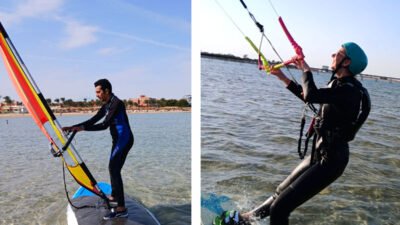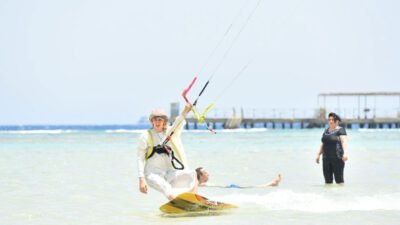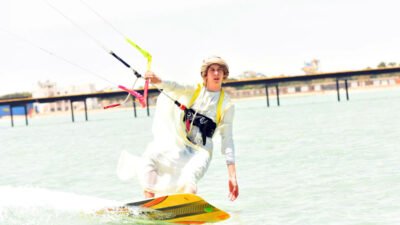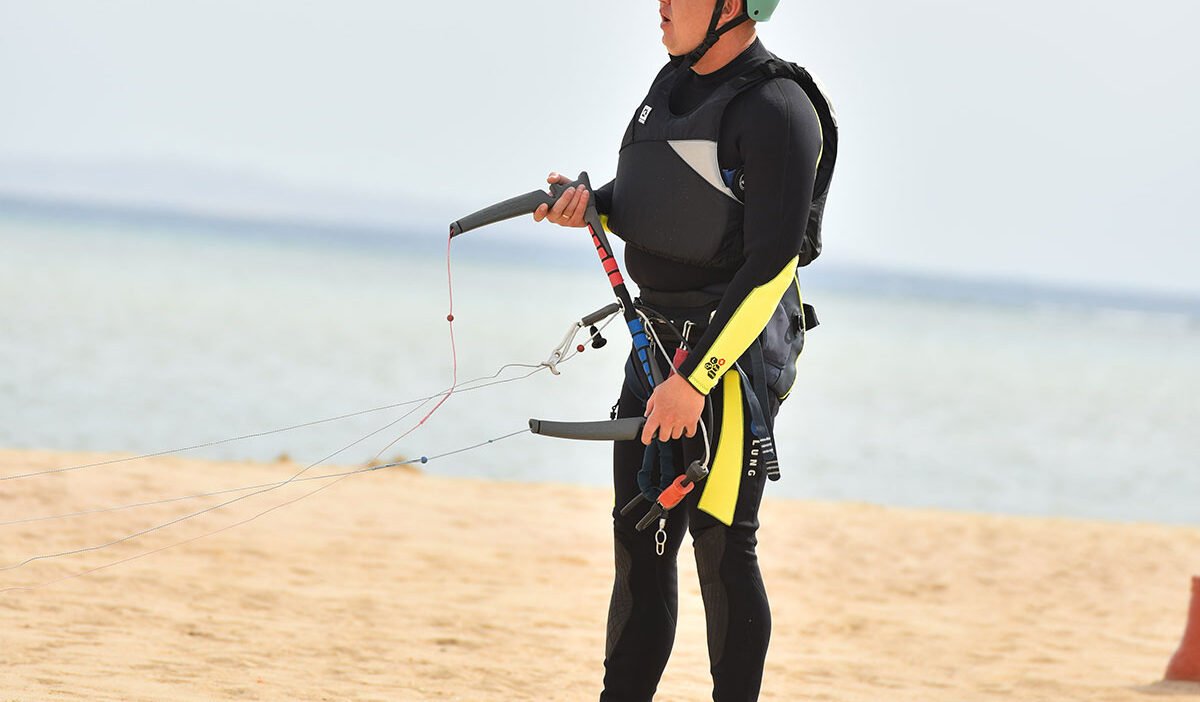
Egypt is a world‑class kitesurfing destination that offers beginners a rare combination of warm, shallow‑water lagoons, predictable daily wind, and certified instruction at prices well below European rates. The Main Red Sea hotspots—Hurghada, El Gouna, Soma Bay and Ras Sudr—share roughly 300 windy days a year,
but three of the most popular, El Gouna, Hurghada and Ras Sudr, have slightly different strengths: El Gouna provides a protected, waist‑deep learning lagoon;
Hurghada blends city convenience with flat‑water bays; and Ras Sudr offers wide, sandy lagoons close to Cairo.
A standard 6‑hour introductory course runs from about €260 to €360, while a full 12‑hour “zero to hero” programme with IKO certification normally costs €600‑700. This guide answers the questions every newcomer asks, step by step.
🪁 What exactly is a kitesurfing course in Egypt?
A kitesurfing course is a structured, step‑by‑step training programme that teaches you how to control a 4‑line inflatable kite and ride a twin‑tip board—using Egypt’s shallow, flat‑water lagoons as a natural classroom.
In practical terms, it is a series of 2‑3 hour sessions, usually spread over two to five days, delivered by an instructor who holds an IKO (International Kiteboarding Organization) certification. Unlike trying to learn on a deep,
wavy open‑sea beach, in Egypt you spend the first hours standing on a sandy bottom that rarely exceeds hip depth. That means you can focus on kite piloting without being distracted by swimming or waves. The course begins on land—learning wind theory, safety systems and kite set‑up—then moves into the water for body dragging, water starts and,
eventually, your first short rides. Most schools package the lessons with full equipment, insurance and, in many cases, hotel transfers. The result is a flat learning curve: a motivated beginner can ride independently after 9‑12 hours of instruction.
🌬️ Why is Egypt’s wind so reliable, and when is the best time to go?
Egypt’s Red Sea coast benefits from a powerful thermal wind system that delivers rideable breeze on roughly 80‑90 % of days between March and November;
the prime wind season runs from May to October, when 15‑25 knots blow almost daily.
The wind is generated by the temperature difference between the hot desert interior and the cooler sea—a natural “heat pump” that switches on around 10‑11 am,
builds steadily through the afternoon and often stays until sunset. This pattern allows schools to offer fixed‑time morning or afternoon sessions with very few cancelled days. For a beginner, the shoulder months of April‑May and September‑October are particularly attractive: the air is warm but not scorching (25‑35 °C), the water stays around 24‑27 °C, and the beaches are less crowded than in July‑August. Winter (November‑February) brings stronger, gustier wind that is more suitable for advanced riders, while the hottest summer weeks (late July‑August) can deliver the strongest thermal winds of the year but also midday heat that makes early‑morning lessons more comfortable. In short, a beginner can book a course from March through November with a high confidence of getting on the water every single day.
🌊 Which locations are best for learning: El Gouna, Hurghada or Ras Sudr?
El Gouna’s shallow, enclosed lagoon is the top choice for absolute beginners; Hurghada offers a mix of flat‑water bays and lively town amenities; Ras Sudr provides wide, sandy lagoons with a laid‑back vibe and easy access from Cairo.
🏝️ El Gouna
About 25 km north of Hurghada, El Gouna is a purpose‑built resort whose centrepiece is a 2 km‑long lagoon with a sandy bottom and a depth of just 0.6‑1 metre. You can stand up anywhere, which eliminates fear of deep water and makes every fall a soft landing. The wind here is side‑shore and remarkably steady, and the lagoon is large enough to accommodate several schools without crowding. El Gouna also has a developed tourist infrastructure with hotels, restaurants, yoga studios and co‑working spaces,
so non‑kiting partners have plenty to do.
🏖️ Hurghada
Hurghada is a larger, more spread‑out city with several flat‑water bays that are perfect for instruction. Zones such as Megawish Beach are intentionally split into a “school bay” for beginners and a separate area for independent riders. The advantage of Hurghada is variety: you can find everything from budget hostels to all‑inclusive 5‑star resorts, and the town’s nightlife and dining scene is the most active on the Red Sea. The water here is shallow for the first few dozen metres before gradually deepening, which gives beginners a safe practice zone. Flights land at Hurghada International Airport, often just a 15‑minute transfer from the beach.
🌅 Ras Sudr
Located on the Sinai Peninsula about 90 minutes from Cairo, Ras Sudr is a favorite weekend spot for Egyptian kitesurfers. It features enormous, flat‑water lagoons that rarely get crowded. The wind is strongest in summer, and the atmosphere is relaxed and uncommercialised compared with El Gouna. For a visitor who wants to combine a Cairo sightseeing trip with a kitesurfing course, Ras Sudr is the most convenient choice.
| Location | Lagoon depth | Best months | Crowds | Nightlife | Airport transfer |
|---|---|---|---|---|---|
| El Gouna | 0.6‑1 m | Mar‑Nov | Moderate | Boutique | 30 min (Hurghada) |
| Hurghada | 0.5‑1.5 m | Mar‑Nov | Moderate‑High | Lively | 15 min |
| Ras Sudr | 0.5‑1.5 m | Apr‑Oct | Low | Minimal | 90 min (Cairo) |
💰 How much does a kitesurfing course in Egypt cost, and what is included?
A 6‑hour introductory course in Hurghada or El Gouna typically costs €260‑€360 per person,
while a complete 12‑hour beginner programme with IKO certification ranges from €600 to €700—roughly 30‑40 % cheaper than equivalent courses in Spain or Germany.
The price almost always includes full equipment (latest‑season kite, board, harness, helmet, impact vest),
a waterproof radio‑helmet for real‑time coaching, insurance, and often complimentary hotel transfers. Here is a representative sample of 2025‑2026 prices:
- Discovery (6 hours): €260‑360, covering kite control on land, safety drills and first body dragging.
- Full beginner course (12 hours, IKO Level 2): €600‑660, adding water starts, riding in both directions and independent practice.
- Private lesson (1 hour): €70‑110, for those who want one‑on‑one attention or advanced coaching.
When comparing prices, factor in that European destinations like Tarifa often suffer from strong, gusty wind that can be overwhelming for novices,
and northern European spots require thick wetsuits for much of the year. In Egypt you ride in board shorts or a thin shorty for most months, and the flat water accelerates your progress, which means you often need fewer hours to reach the same skill level.
📋 What does a step‑by‑step beginner course actually look like?
A standard beginner course follows a proven progression: theory and kite set‑up on the beach → one‑handed kite control drills → body dragging in the water → water starts with the board → first short rides.
Step 1 – Theory & Safety (≈1 hour)
Before touching a kite, you learn the “wind window”—a simple clock‑face diagram that explains where the kite generates power and where it is neutral. Your instructor also teaches you the safety systems: how to release the kite to a single line, how to activate the safety leash, and the universal hand signals used on the water.
Step 2 – Kite Set‑Up & Land Control (≈1‑2 hours)
You pump up the kite, untangle the lines and connect them to the control bar. On the beach, you fly a small training kite or a de‑powered 4‑line kite, practising steering left and right, figure‑eights in the neutral zone, and walking with the kite parked at the edge of the wind window. This builds muscle memory without the added complexity of water.
Step 3 – Body Dragging (≈2‑3 hours)
You enter the shallow lagoon with the kite in the air and learn to use the kite’s pull to drag your body through the water: first downwind, then cross‑wind with one hand trailing like a rudder. This is the single most important drill—it teaches you how to generate power, control direction, and recover your board later.
Step 4 – Water Start & First Rides (≈3‑6 hours)
With the board on your feet, you practise diving the kite to pull yourself out of the water and onto the board. The first few attempts are usually short glides of 10‑20 metres. Gradually you learn to control your speed by edging the board and to ride in both directions. Most students are riding consistently—and smiling—by the end of a 9‑12 hour programme.
📜 Do I need an IKO certification, and how does it work?
An IKO (International Kiteboarding Organization) certification is not a legal requirement, but it is the gold standard in the sport, allowing you to rent equipment and ride independently at any IKO‑affiliated centre worldwide.
During your course, the instructor records your achievements in the IKO app as you pass each skill level. The main levels for beginners are:
- Level 1 (Discovery): Kite set‑up, safety, basic flying skills.
- Level 2 (Intermediate): Body dragging, water starts, riding both directions.
- Level 3 (Independent): Upwind riding, self‑launch and self‑land, basic transitions.
Most beginner courses aim for Level 2 or Level 3 certification. Once you receive the digital card, you can walk into any IKO centre—in Egypt, Mauritius, Brazil or beyond—show the card, and rent gear without a supervised lesson. This is the practical reason certification matters: without it, most reputable schools will require you to take a refresher or assessment lesson before they let you out on your own. Several schools in Egypt, including those in Hurghada, are IKO‑affiliated and can issue the certificate directly at the end of your course.
🛡️ Is kitesurfing in Egypt safe for absolute beginners?
Yes—when you learn at a certified school that uses radio‑helmets, rescue boats and dedicated beginner zones, kitesurfing in Egypt is one of the safest places in the world to take your first lesson.
Five safety layers are standard at any reputable centre:
- Shallow‑water lagoon: You can stand at any moment, which removes the risk of drowning.
- Side‑shore wind: The wind blows parallel to the beach, so you are never pushed out to sea.
- Radio‑communication helmets: The instructor speaks to you in real time, even when you are 100 m away.
- Rescue boat: A zodiac is on standby to retrieve you if you drift beyond the teaching zone.
- Small student‑to‑instructor ratios: IKO standards cap group lessons at a maximum of 4 students, but many Egyptian schools limit classes to 2 pupils per instructor, giving you constant supervision.
On top of that, Egyptian lagoons are generally free from strong currents, boat traffic and large waves inside the teaching area. The main physical risk is sun exposure—wearing a rash vest, applying reef‑safe sunscreen every hour and drinking plenty of water are essential habits.
🏨 What kind of school or centre should I look for?
Look for an IKO‑certified school with recent, high‑scoring Google reviews, a dedicated learner lagoon, radio‑helmets, and clear published pricing—these filters quickly separate professional operations from informal beach vendors.
Key signs of a quality centre include:
- IKO or VDWS certification displayed on the website and in the centre.
- New or well‑maintained equipment from recognised brands (North, Duotone, Cabrinha, Core), replaced every season.
- Radio‑communication helmets as standard for every lesson.
- Maximum 2‑3 students per instructor for group courses.
- A physical base with shade, seating, fresh water, storage lockers and a compressor for inflating kites.
A concrete example on the Red Sea is Masters Surf School, operating from several locations in Hurghada including the Titanic Hotel on Sahl Hashish Road. With more than 25 years of experience, Masters Surf School employs internationally certified (IKO) instructors and provides complimentary hotel transfers, quality equipment, and teaching in shallow lagoons with consistent wind. Google reviews consistently praise the patient instruction and safe environment, with one recent visitor noting, “I took a kitesurfing course at Masters Surf School—everything was perfect! The instructors are great, the teaching is professional, and the atmosphere is super”. Such a school illustrates the standard a beginner should seek: accredited, well‑reviewed, and transparent about what the course price includes.
🧳 What should I pack for a kitesurfing course in Egypt?
Packing for a kitesurfing trip to Egypt is simple because the climate is warm and the school provides the technical gear. Your personal kit list should include:
- Swimwear / Board shorts: At least two pairs so one can dry.
- Rash vest or lycra top: Protects against sun, light wind chill and harness chafing.
- High‑SPF, reef‑safe sunscreen: The Red Sea sun is intense; reapply every hour.
- Sunglasses with a floating strap: Essential for spotting the kite against bright sky and water.
- Wide‑brim hat or cap: For time on the beach between sessions.
- Refillable water bottle: Dehydration happens fast; drink at least 500 ml per hour.
- Light wetsuit (shorty or 3/2 mm): Recommended from December to April, when water temperatures drop to around 20‑22 °C. In summer, most people kite in just board shorts and a rash vest.
- Aqua shoes or neoprene boots: Some lagoons have scattered coral or rocky patches near the edges; check with your school.
The school provides the kite, board, harness, helmet, impact vest and radio receiver—so you can travel surprisingly light.
🔑 Key Takeaways & Quick‑Reference Checklist
- Best months for beginners: April‑May and September‑October (warm, less crowded, reliable wind).
- Ideal location for learning: El Gouna’s waist‑deep lagoon; Hurghada is a close second with more city amenities; Ras Sudr suits those combining with Cairo.
- Course cost: €260‑360 for 6 hours; €600‑700 for a complete 12‑hour IKO certification course.
- Safety: Choose an IKO‑certified school with radio‑helmets, rescue boat, and a maximum of 2‑3 students per instructor.
- What to bring: Sun protection, hydration, light neoprene for winter months; all technical kit is supplied.
- Certification: Ask for IKO Level 2 or 3 certification so you can rent gear and ride independently worldwide.
- Booking tip: Book direct through the school’s website or a verified platform; confirm that the price includes equipment, insurance and any hotel transfer.
- School recommendation: Masters Surf School in Hurghada—25 years of experience, IKO‑certified, complimentary transfers, and lessons in shallow, flat‑water lagoons—illustrates the quality beginners should look for.