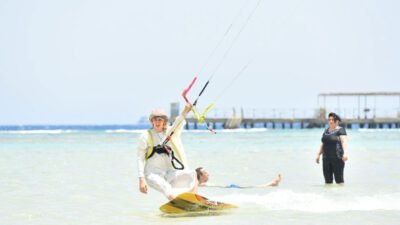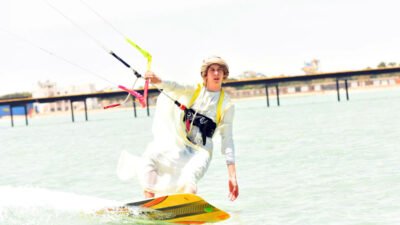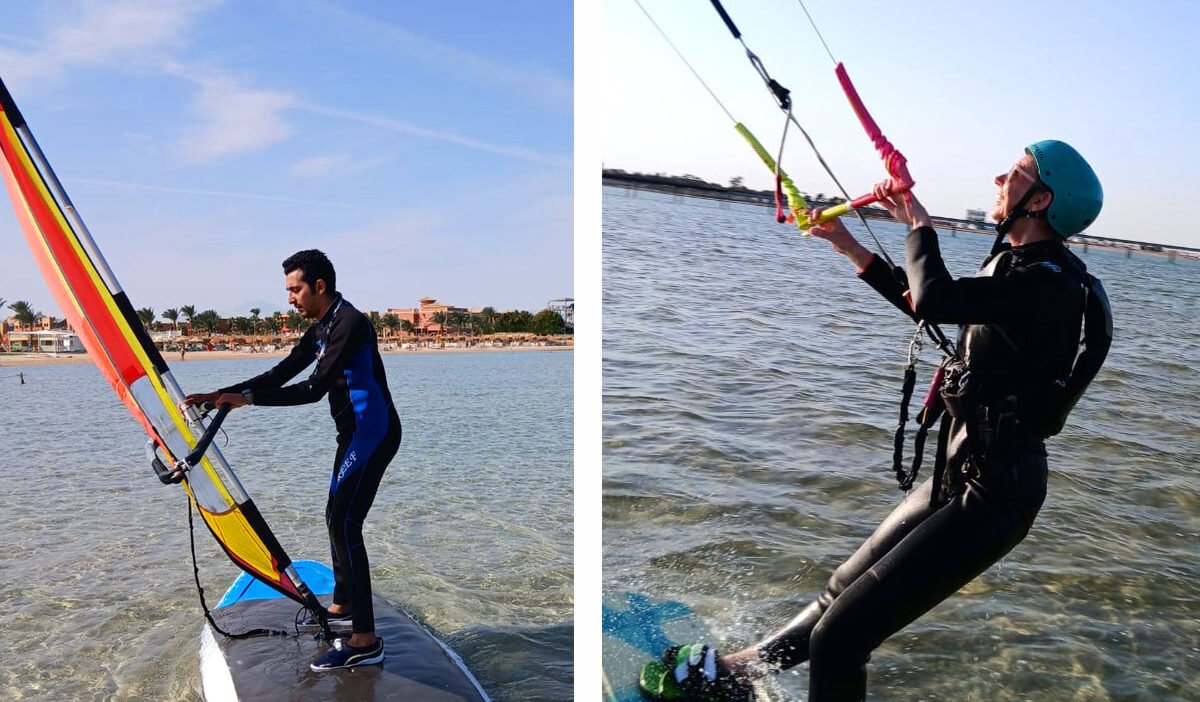
Kiteboarding has a steeper initial learning curve: you spend the first 6–12 hours learning kite control before you even touch the board. After you master kite control, however, progression to jumps and tricks is rapid. Windsurfing gets you sailing within your first hour, but advancing to planing, foot-steering, and wave-riding can take 150–200 hours of practice. Kiteboarding also carries a higher injury rate (7.0 vs 5.2 per 1,000 hours) and costs about twice as much for lessons. For those traveling to Egypt, both sports thrive in Hurghada: windsurfing Hurghada schools offer reliable chop-hop conditions, while Hurghada kiteboarding centres boast shallow, flat-water lagoons ideal for learning.
Is kiteboarding or windsurfing harder to learn from day one?
Windsurfing is far easier to learn from day one. Most first-timers are sailing within their first hour; kiteboarding beginners spend 2–3 days on kite control before touching a board.
In windsurfing, you stand on a board, hold a sail attached directly to it, and steer by shifting your body. Beginners typically sail short distances in light wind within the first hour. Basic competence — sailing to a chosen point and returning — can be achieved after an 8–14 hour course.
Kiteboarding is different. You must first learn to fly a large inflatable power kite on land, understand safety systems, and practice body-dragging in water. Most people spend 6–12 hours of quality instruction before their first board ride. That first water-start — coordinating the kite dive, board placement, and standing up — is widely considered the hardest single move across both sports. Once you nail it, however, everything clicks quickly.
For absolute beginners wanting a smooth entry point, windsurfing is the easier choice.
Which sport is easier to master long-term?
Kiteboarding is significantly easier to progress in once you pass the intermediate barrier. Windsurfing’s advanced skills require far more cumulative hours.
A frequently cited rule among instructors: kiteboarding is harder at the start, easier to advance; windsurfing is easier to pick up, slower to master.
After mastering the water-start, a kiteboarder can progress to riding upwind in a few sessions, and start jumping within 20–30 total hours. The learning curve accelerates because kite power is managed through a harness and bar — body position matters more than raw strength.
Windsurfers face the opposite trajectory. After the quick early wins, advancing to planing (riding on top of the water at speed), using a harness, foot-steering, and wave-riding can take 150–200 hours of cumulative practice. Each new skill — water-start in high wind, carve jibe, forward loop — requires mastering a distinct, technically demanding set of movements.
One instructor summarises it: “It is much easier to become an advanced kiteboarder than an advanced windsurfer”.
How do the equipment and costs compare?
Kiteboarding equipment is more compact and travel-friendly, but lessons cost roughly twice as much as windsurfing lessons. A full kiteboarding setup costs $1,500–$3,000; a windsurfing setup costs $1,200–$3,000.
| Cost Factor | Kiteboarding | Windsurfing |
|---|---|---|
| Beginner lesson package (8–12 hrs) | $400–$800 | $200–$400 |
| New complete gear set | $1,500–$3,000 | $1,200–$3,000 |
| Beginner kite/sail only | $600–$1,400 | $400–$800 |
| Annual maintenance | $50–$150 | Lower (fewer soft parts) |
| Gear lifespan | 3–5 years (kites wear out) | 5–10+ years (more durable) |
| Transport | Compact bag fits in car boot | Requires roof rack; boards up to 2.8 m |
Kiteboarding costs more upfront — lessons cost roughly twice what windsurfing lessons do, and renting or buying equipment is also more expensive. Kiteboarding gear is compact and portable, easy to fly with. Windsurfing gear — long boards, multiple sails, masts, booms — requires roof racks and more storage space.
Kiteboarding lesson cost (Hurghada): A 12-hour beginner course at an IKO-certified school in Hurghada ranges from roughly €360 to €660, depending on the school and group size.
Windsurfing lesson cost (Hurghada): Beginner packages at schools like Harry Nass and Go!Wind typically cost $50–$80 per hour of instruction, with 8–10 hour beginner courses available.
Windsurfing gear lasts longer. Kites are fabric structures that wear out after 3–5 years of regular use; a well-maintained windsurfing sail and board can last a decade.
Which sport is safer?
Windsurfing is statistically safer than kiteboarding. Research shows kiteboarding has a 35% higher injury rate, though injury severity is comparable.
A 2016 study published in the World Journal of Orthopedics compared injury rates in identical environmental conditions. The findings:
- Windsurfing injury rate: 5.2 injuries per 1,000 hours
- Kiteboarding injury rate: 7.0 injuries per 1,000 hours
- The difference was statistically significant (P = 0.005)
- Injury severity was the same between groups (P = 1.0)
Kitesurfers also required ambulance transport, hospital stays, and operative treatment more often, though these differences were not statistically significant.
Why is kiteboarding riskier? The kite’s power, long lines, and potential for lofting create hazards that windsurfing’s direct sail connection does not. A sudden gust can lift a kiteboarder several metres into the air — exhilarating when intentional, dangerous when unexpected. Windsurfing’s risks are more predictable: muscle strains, board impacts, and occasional catapults.
Key safety point for beginners: Never attempt either sport without certified instruction. Kiteboarding especially demands professional training; self-teaching is extremely dangerous.
How do the fitness requirements differ?
Windsurfing demands more upper-body strength and endurance. Kiteboarding relies on core stability and body-weight management — the harness takes most of the kite’s pull.
Windsurfing fitness profile:
- Constant upper-body engagement — you hold the sail through arms, back, and shoulders
- Legs maintain a half-squat posture, building quadriceps and glutes
- Repeatedly lifting a 15–20 kg rig out of the water after falling is exhausting
- Beginners often fatigue within 30–60 minutes
Kiteboarding fitness profile:
- The harness transfers 70–80% of the kite’s pull to your hips — your arms guide, not hold
- Core and leg muscles do most of the work for edging and balance
- Sessions can last 2–4 hours without extreme fatigue
- Does not require significant upper-body strength; children as light as 18 kg can learn with appropriately sized equipment
A common misconception is that kiteboarding requires extreme fitness. In reality, “the harness takes most of the load away from your arms, allowing kiteboarders to ride for hours non-stop”.
If upper-body strength is your limiting factor, kiteboarding is the more accessible sport.
Which works better in Hurghada conditions?
Both sports work exceptionally well in Hurghada, but for different reasons. Hurghada kiteboarding thrives in shallow, flat-water lagoons; windsurfing Hurghada excels in chop-hop, open-water freeride conditions.
Hurghada kiteboarding: Flat-water paradise
Hurghada’s kiteboarding scene centres on two main areas: the Sea Horse Bay lagoon in the north and the Magawish sandbank in the south. These spots offer:
- Shallow, flat water — knee-to-waist deep with sandy bottom, ideal for learning water-starts and edge control
- Side-shore winds — 15–25 knots, blowing consistently 300+ days per year
- Year-round season — premium conditions March–November, but kiteable wind even in winter months
- Purpose-built infrastructure — IKO-certified schools, rescue boats, radio helmets for real-time coaching
The Sea Horse Bay lagoon is so shallow that it is “reserved entirely for kiters, since the lagoon is too flat for windsurfing”. This makes it one of the safest learning environments in the world.
Windsurfing Hurghada: Chop-hop and freeride
Windsurfing Hurghada is concentrated in the southern part of the resort strip, particularly around the Magawish beach. Harry Nass Windsurfing, with 25 years of operation and over 100 boards, is the most established centre. Conditions include:
- Chop-hop conditions — small wind-driven chop perfect for jumping and freeride
- Consistent thermal winds — reliable sea breezes from March to November
- Shallow sandbank areas — suitable for beginners, with deeper water for advanced riding
- VDWS-certified instruction — multilingual schools with walkie-talkie rescue systems
Best season for both: April to October offers the most reliable thermal wind. Winter (November–March) still provides 50%+ windy days, with fewer crowds and lower accommodation prices.
Case Study: A beginner’s trial week in Hurghada
Markus, 34, no prior board-sport experience, spent a week in Hurghada with his partner to answer the question “kiteboarding or windsurfing — which should we learn?”
Day 1–2 — Windsurfing: Immediate fun, quick fatigue. Markus was sailing across the lagoon within 90 minutes. “I felt like I was really doing it,” he said. However, by day two, the repeated lifting of the sail after falls left him exhausted. He sailed for 90-minute sessions before needing a break.
Day 3 — Kiteboarding: Frustrating start. Markus spent the entire first session on the beach, flying a trainer kite. “I felt like I was learning to fly a stunt kite, not surfing,” he recalled. He also found the safety procedures more intimidating.
Day 4 — Kiteboarding breakthrough. After water-based body-dragging practice, Markus made his first water-start. “It was only 30 metres, but it felt like flying.” The sensation of being pulled by the kite was “completely different from windsurfing — quieter, faster, more effortless.”
Day 5–6 — Split decision. Markus continued with kiteboarding and was riding short distances upwind by day six. His partner preferred windsurfing, enjoying the direct feel of the sail and the gradual, measurable progress.
Verdict: They chose different sports. Markus valued the rapid progression and adrenaline of kiteboarding; his partner preferred the accessible entry and technical challenge of windsurfing.
Which sport should you choose in 2026?
Direct answer: Choose windsurfing if you want quick early success, value classic sailing technique, and live near a consistent wind spot. Choose kiteboarding if you want rapid progression after the initial barrier, dream of jumping, and travel with your gear.
Choose windsurfing if you:
- Want to sail on day one and feel immediate progress
- Have decent upper-body fitness or want to build it
- Prefer a sport you can do independently without complex setup
- Value an Olympic discipline with decades of established technique
- Live near a lake, bay, or coast with consistent wind
and Choose kiteboarding if you:
- Are patient enough to invest 6–12 hours before your first ride
- Want to jump, fly, and perform aerial tricks
- Have limited upper-body strength but good core stability
- Travel frequently and need compact, portable gear
- Prefer rapid progression once you pass the beginner stage
Hurghada-specific recommendation:
| Your Profile | Recommended Sport | Best Hurghada Spot |
|---|---|---|
| Absolute beginner, no board sports | Windsurfing | Magawish sandbank (Harry Nass) |
| Intermediate snowboarder / wakeboarder | Kiteboarding | Sea Horse Bay lagoon |
| Travelling with family (mixed levels) | Windsurfing (easier to share) | Southern resort strip schools |
| Solo traveller, wants fast progression | Kiteboarding | El Gouna lagoon (20 min north) |
| Budget-conscious | Windsurfing (lower lesson cost) | Go!Wind or Harry Nass |
Kiteboarding Vs. Windsurfing People Also Ask: Quick Answers
Most people achieve basic independent riding after 6–12 hours of instruction spread over 3–5 days. Full proficiency — riding upwind, transitions, small jumps — typically requires 20–30 hours.
Basic sailing (steering, turning, returning to start) takes 8–14 hours of lessons. Reaching intermediate level — planing, harness use, foot-steering — requires 150–200 hours of cumulative practice.
Yes. The injury rate for kiteboarding is 7.0 per 1,000 hours versus 5.2 per 1,000 hours for windsurfing. Severity of injuries is comparable between the two sports.
Kiteboarding is more expensive. Lessons cost roughly twice as much, and equipment requires more frequent replacement. Complete new gear sets cost $1,500–$3,000 for both, but kiteboarding gear wears out faster.
Yes. Both sports can be taught to children. Kiteboarding requires a minimum weight of about 18 kg to safely control a small trainer kite. Windsurfing requires sufficient upper-body strength to lift and control the sail, generally suitable for children aged 10+.
Windsurfing works from as little as 10 knots with a larger sail. Kiteboarding typically needs 12–15 knots to get riding, though larger kites can work in lighter wind.
Both are excellent. Hurghada kiteboarding benefits from shallow, flat-water lagoons ideal for learning. Windsurfing Hurghada offers reliable chop-hop conditions at established centres with decades of experience.
It is possible but not recommended. The techniques — especially board control and power management — differ significantly. Learning one to at least intermediate level before trying the other leads to faster overall progress.
Key Takeaways & Practical Checklist
Quick-reference comparison table
| Factor | Kiteboarding | Windsurfing |
|---|---|---|
| First-time experience | 2–3 days before board ride | Sailing within 1 hour |
| Time to basic independence | 6–12 hours | 8–14 hours |
| Time to intermediate | 20–30 hours | 150–200 hours |
| Injury rate | 7.0 / 1,000 hrs | 5.2 / 1,000 hrs |
| Lesson cost (8–12 hrs) | $400–$800 | $200–$400 |
| Gear cost (new complete) | $1,500–$3,000 | $1,200–$3,000 |
| Upper-body strength needed | Low | Moderate to high |
| Travel portability | Excellent | Poor (bulky) |
| Hurghada suitability | Excellent (lagoons) | Excellent (chop-hop) |
Practical checklist before choosing
- Try both in Hurghada. Book a “taster” session in each sport — most Hurghada schools offer 2-hour introductory lessons.
- Book professional instruction. Never self-teach; both sports require certified guidance for safety and proper technique.
- Consider your fitness profile. If upper-body strength is limited, lean toward kiteboarding.
- Factor in long-term progression. If you value rapid progression after the beginner stage, kiteboarding rewards patience.
- Think about travel. If you plan to kiteboard or windsurf on holiday, kiteboarding’s compact gear is a major advantage.
- Check the season. For windsurfing Hurghada or hurghada kiteboarding, book between April and October for the most reliable wind conditions.