Kitesurfing for first responders is the application of kiteboarding — a water sport where a large controllable kite pulls a rider across the water on a small board — as a structured therapeutic and resilience‑building activity specifically tailored to the needs of paramedics, firefighters, police officers, emergency medical technicians, and military veterans.
The sport combines intense physical exertion, forced present‑moment focus,
and immersion in a natural aquatic environment to deliver measurable reductions in stress, anxiety, and symptoms of post‑traumatic stress.
Recognised programmes such as Wind Sports for Wounded Warriors and Stoke Therapy have demonstrated through both participant testimony and independent academic assessment that learning to master the wind and water can accelerate emotional recovery, rebuild self‑confidence, and restore the peer‑connection that many responders lose after leaving service.
For those ready to begin, Hurghada, Egypt offers the safest, most affordable, and most consistently windy classroom on earth,
with IKO‑certified instruction and shallow‑water lagoons that allow a complete beginner to progress from zero to independent riding in three to five days.
What is kitesurfing for first responders?
Kitesurfing for first responders is the deliberate use of kiteboarding — a water sport that combines elements of surfing, wakeboarding, and paragliding — as a therapeutic intervention and resilience tool tailored to the unique physiological and psychological demands placed on emergency service personnel.
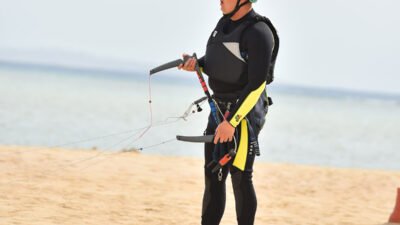
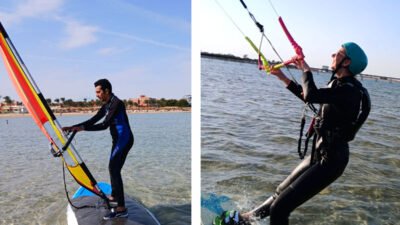
To understand the definition fully, it is necessary to first explain each component. Kitesurfing (also called kiteboarding) involves a rider standing on a small board while controlling a large inflatable kite via a control bar connected to lines approximately 25 metres long. The kite captures wind energy and converts it into forward propulsion, allowing the rider to plane across the water at speeds of 15 to 40 kilometres per hour.
The kite is not held by arm strength alone; it connects to a harness worn around the waist or seat,
distributing the load across the rider’s core and legs. This mechanical arrangement means the sport is accessible to a wide range of ages and fitness levels, not only elite athletes.
The term “first responders” encompasses paramedics, emergency medical technicians, firefighters, police officers, search‑and‑rescue personnel,
and — in many programme contexts — military veterans whose service exposed them to operational trauma. These individuals share a common occupational hazard: repeated exposure to critical incidents, life‑threatening situations, and human suffering that cumulatively produces elevated rates of post‑traumatic stress injury, anxiety, depression, and burnout compared to the general population.
When these two elements combine, kitesurfing becomes a vehicle for what practitioners call adventure‑based or experiential therapy. Rather than processing trauma through verbal dialogue alone, the participant engages in a physically demanding, cognitively absorbing activity that requires complete present‑moment attention, thereby interrupting ruminative thought patterns and creating what psychologists term a “flow state.” Research on surfing therapy — a closely related discipline — has demonstrated that water‑based interventions can provide a felt sense of respite from PTSD symptoms and facilitate what veterans describe as an “unlearning” of war’s impact on the body.
Key distinction: Kitesurfing for first responders is not merely recreational. It is a structured, often professionally facilitated process designed to achieve specific therapeutic outcomes: reduced hypervigilance, improved emotional regulation, restored self‑efficacy, and rebuilt peer social bonds.
Why does kitesurfing benefit first responders specifically?
Kitesurfing benefits first responders because it directly counteracts four specific harm pathways that emergency service work engrains in the body and mind: (1) chronic hyperarousal, (2) social isolation from civilian communities, (3) loss of self‑efficacy following injury or burnout, and (4) cumulative stress that resists resolution through verbal therapy alone.
The mechanism of action is both physiological and psychological. On a physiological level, kitesurfing is a full‑body workout that engages the core, legs, back, and arms simultaneously while maintaining an elevated heart rate for sustained periods. Research indicates that physical activity in natural settings can reduce anxiety levels by up to 30%. The sport triggers the release of endorphins and dopamine — neurochemicals directly responsible for mood elevation and stress reduction — while the rhythmic sound of water and wind activates the parasympathetic nervous system, which governs the body’s “rest and digest” response.
On a psychological level, kitesurfing demands what clinicians call “forced mindfulness.” When a rider is on the water managing a 10‑square‑metre kite in 20 knots of wind, the brain has no cognitive bandwidth remaining for rumination on past traumatic events or anxious anticipation of future threats. The wind window — the three‑dimensional arc of sky in which the kite generates power, with the power zone directly downwind and the neutral zone at the edges — becomes the rider’s entire universe of attention. This present‑moment absorption is precisely the state that mindfulness meditation seeks to cultivate, but kitesurfing achieves it through physical action rather than seated contemplation, which many first responders find more accessible.
The peer‑connection dimension is equally critical. Stoke Therapy, a nonprofit organisation founded by firefighter, EMT, and Army veteran Gage Hall, explicitly structures its adventure‑based interventions around community rather than isolation. “That community piece is the biggest thing that’s messing up this population,” Hall explains. “It’s the loneliness, the isolation. Stoke gives them connection again”. Programs like Wind Sports for Wounded Warriors (WS4WW) operate on the same principle, using the shared challenge of learning a demanding sport to recreate the bonds of trust and mutual reliance that characterised participants’ service experience.
Furthermore, a systematic review of body‑ and movement‑oriented interventions for first responders found that such approaches show promise in reducing PTSD risk by enhancing neurophysiological stress‑response regulation, including improved psychological resilience and somatic awareness. While more controlled research is needed specifically on kitesurfing, the existing evidence base for surf therapy — independently assessed through academic evaluation of programs like Surfwell, which is delivered by emergency services staff for emergency services staff — demonstrates that participants struggling with stress, trauma, and PTSD return to work faster after water‑based interventions.
What existing kitesurfing programmes serve first responders and veterans?
Two primary organisations provide structured kitesurfing and wind‑sport experiences specifically designed for first responders, military veterans, and wounded service personnel: Wind Sports for Wounded Warriors (WS4WW) and Stoke Therapy, with additional related programmes operating in the surf‑therapy space.
Wind Sports for Wounded Warriors (WS4WW)
WS4WW is an independent 501(c)(3) nonprofit organisation incorporated in 2012 and operating across multiple coastal locations in the United States, including South Carolina, Florida, and Georgia. Its mission is to introduce injured veterans to the active, healthy lifestyles of wind sports — primarily kiteboarding — through multi‑day retreats that provide professional instruction, equipment, lodging, and meals at no cost to participants.
A typical WS4WW retreat lasts five days and serves cohorts of approximately six participants. Instructors include both professional kiteboarding coaches and program graduates who have themselves overcome service‑related injuries. Dustin Humphrey, a Marine Corps veteran who suffered a traumatic brain injury from multiple improvised explosive device attacks, described his experience: “The power of the kite, learning to control it to rip yourself out of the water was impressive, intimidating and therapeutic at the same time”. Nathan Nelson, an Air Force veteran and Purple Heart recipient who became WS4WW’s first paraplegic beneficiary, stated that “Wind Sports are one of the best ways of healing for amputees and people with traumatic brain injuries and PTSD”.
Stoke Therapy
Stoke Therapy is a nonprofit organisation that helps first responders, veterans, and active‑duty service members heal through adventure‑based therapy spanning rock climbing, surfing, scuba diving, hiking, and — by logical extension of its methodology — kiteboarding. Founded by Gage Hall, the programme is built on the principle that “you can’t think your way out of trauma — you have to move through it”.
Stoke Therapy’s approach differs from traditional talk therapy in three specific ways: it is experiential (the activity becomes the conversation), it is community‑based (participants heal alongside peers with shared occupational backgrounds), and it prioritises joy — what Hall calls “joy therapy” — as a deliberate retraining of the brain’s capacity to feel safe in positive emotional states.
Related Programmes (Surf‑Based)
Several surf‑therapy programmes that serve the same population offer transferable evidence and methodology. Surfwell, recognised by Surfing England, is the first surf‑therapy programme specifically tailored to emergency services and delivered by emergency services staff. It uses serving officers trained as both surf instructors and mental health practitioners to work with participants through a structured programme capitalising on cold‑water immersion, overcoming fear, and connecting with nature. Independent academic assessment has verified that the programme helps officers and staff struggling with stress, trauma, and PTSD return to work faster.
How does a beginner learn to kitesurf, step by step?
A beginner learns to kitesurf through a structured, progressive curriculum standardised by the International Kiteboarding Organization (IKO). The complete beginner pathway moves through three certification levels — Discovery, Intermediate, and Independent — typically requiring 9 to 12 hours of instruction spread over three to five consecutive days.
Level 1: Discovery (Land‑Based, 2–4 Hours)
Level 1A — On Land (20–45 minutes). The student learns to identify safe wind directions and kiting conditions, assess spot hazards, set up a trainer kite, and understand safety systems.
Level 1B — In the Water. The student develops basic flying skills with a trainer kite — a small, 2–3 m² kite that teaches steering without full power — learns to launch and land with an assistant, and begins walking while flying the kite to understand directional control.
Level 1C. The student progresses to setting up a full‑size 4‑line or 5‑line de‑power kite, performs pre‑flight equipment checks, and learns international communication hand signals.
Level 1D. The student learns to control the kite while hooked into the harness — the critical transition from arm‑flying to body‑flying — and demonstrates full control of the de‑power system, which allows the rider to reduce kite power instantly by pushing the control bar away.
Level 1E. The student performs a quick‑release activation (the safety mechanism that instantly disconnects the rider from the kite), recovers the bar and kite, and executes a self‑landing.
Level 2: Intermediate (Water‑Based, 9–12 Hours Total)
Level 2F. The student enters and exits the water independently while controlling the kite, performs a water re‑launch, and executes the first body drag downwind — allowing the kite to pull the rider through the water without a board.
Level 2G. The student learns upwind body dragging — using body position as a rudder to steer back to a lost board — a skill essential for independent riding.
Level 2H. The student understands the power stroke required for a water start (diving the kite into the power zone to generate lift) and practices positioning the board on the feet.
Level 2I. The student performs the first water start in both directions, rides a short distance, and comes to a controlled stop. This is the milestone moment when a beginner first feels the sensation of planing across the water.
Level 3: Independent
Level 3J–3K. The student learns to control riding speed by edging the board, rides consistently in both directions, and — critically — rides upwind. Upwind riding is the gateway skill that defines independence: once a rider can go upwind, they can return to their starting point without assistance.
Level 3L–3M. The student performs direction changes without stopping, executes a self‑rescue and full pack‑down in deep water, and demonstrates right‑of‑way knowledge.
Upon reaching Level 3, the student receives an IKO Kiteboarder Card — a digital certification recognised at every IKO‑affiliated centre worldwide, functioning like a passport that grants equipment rental and independent riding privileges without needing to retake a beginner course.
Why is Hurghada, Egypt the optimal location for a first responder to learn kitesurfing?
Hurghada, Egypt is the optimal location for a first responder to learn kitesurfing because it simultaneously provides the three conditions that eliminate the primary barriers to learning: shallow, flat‑water lagoons where a student can stand at any time, side‑onshore wind that pushes a fallen rider back toward the beach rather than out to sea, and warm water temperatures of 26–30°C from May through October that require no wetsuit.
The Al Ahyaa Lagoon Advantage
Hurghada’s Al Ahyaa Lagoon is a large, sheltered body of water separated from the open Red Sea by a natural reef break. The reef eliminates ocean swell, creating a massive area of flat water with a sandy bottom at waist‑to‑chest depth extending hundreds of metres from shore. For a first responder who may be managing hypervigilance or anxiety alongside learning a new skill, the ability to simply stand up after a fall — rather than swimming in deep water while tangled in lines — fundamentally changes the psychological experience of the lesson. The fear of drowning or losing control is replaced by the knowledge that the lagoon floor is always within reach.
Wind Safety and Consistency
The prevailing wind in Hurghada blows from the north to north‑northwest at a side‑onshore angle, meaning it pushes riders along the coast rather than out toward open water. This wind direction is universally recognised by kitesurfing instructors as the safest possible configuration for teaching. During the peak season from May through October, thermal winds — generated when the desert heats up and draws cool air from the sea — produce consistent speeds of 15 to 25 knots almost daily, with some periods experiencing weeks without a single wind‑free day.
Cost and Logistical Accessibility
A complete 12‑hour IKO beginner course in Hurghada costs between €350 and €500 (approximately US $380–$550), including all equipment, certification, and in many cases complimentary hotel transfers. This is approximately 40–60% of the cost of an equivalent course in Europe or the Caribbean. Direct flights to Hurghada International Airport (HRG) are available from major European and Middle Eastern hubs, and a 30‑day tourist visa can be obtained on arrival for $25 USD.
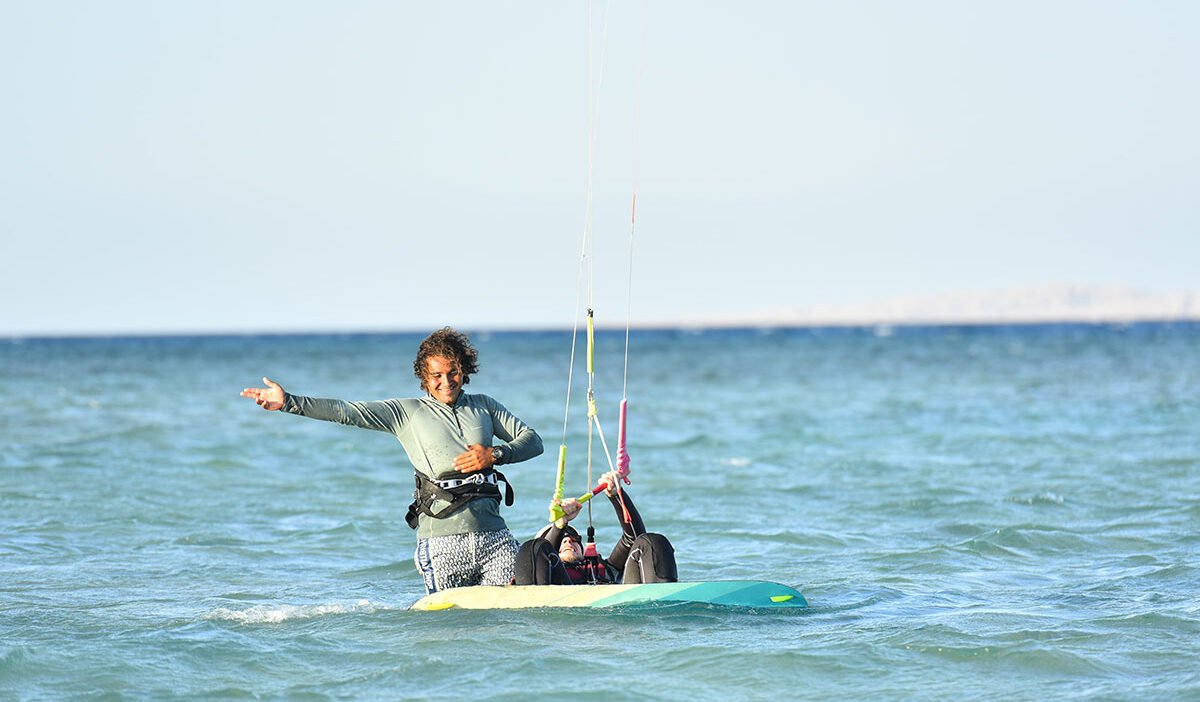
Masters Surf School, operating from four locations along the Red Sea coast with over 25 years of experience, provides IKO‑certified instruction, radio‑helmet communication (allowing the instructor to coach in real time while the student is on the water), and a structured beginner programme designed to take a student from zero to independent riding in three to five days.
What is IKO certification and why does it matter for first responders?
IKO certification is a globally standardised credential issued by the International Kiteboarding Organization that validates a rider’s skill level. It functions as an international passport for kitesurfing: once a first responder holds an IKO Level 3 (Independent) card, they can walk into any IKO‑affiliated centre worldwide and rent equipment, book advanced coaching, or join kite safaris without retaking a beginner course.
The IKO curriculum is structured into clearly defined, progressive levels — Discovery, Intermediate, Independent, and Advanced — each with specific, demonstrable competencies. For first responders, whose professional training culture already values certification, competency‑based assessment, and clear progression pathways, the IKO framework provides a familiar structure. It replaces the ambiguity of “am I good enough?” with objective, measurable milestones.
All Masters Surf School instructors hold IKO certification. Upon completing a course, the student receives a digital IKO Kiteboarder Card stored on their phone, listing the levels achieved. This card is accepted at kite centres from Brazil to Bali to the Caribbean, meaning the skill investment made in Hurghada is portable worldwide.
Additionally, the IKO safety curriculum — which covers spot assessment, hazard identification, quick‑release activation, self‑rescue, and right‑of‑way rules — aligns closely with the risk‑management mindset that first responders already possess. The systematic, safety‑first approach to learning resonates with professionals who understand from experience that proper protocols prevent catastrophic outcomes.
What should a first responder expect during their first kitesurfing lesson in Hurghada?
A first responder should expect a structured, safety‑first progression that begins on the beach and only moves to the water once fundamental kite‑control skills are demonstrated.
The first session (typically 3–4 hours) follows a specific sequence:
- Site and wind assessment. The instructor identifies the day’s wind direction, strength, and any hazards, explaining why the chosen location is safe for the lesson. This appeals directly to the operational mindset of a first responder, who is trained to assess scenes before acting.
- Kite setup and safety briefing. The student learns to assemble a 4‑line inflatable kite, connect lines, and — critically — activate the quick‑release safety system and leash. The instructor demonstrates that releasing the bar instantly depowers the kite, and the student practices this repeatedly until it becomes automatic.
- Trainer kite flying. Using a small 2–3 m² trainer kite on short lines, the student learns to steer through the wind window — imagining the sky as a giant clock face with the power zone at 12 o’clock and neutral zones at 9 and 3. The trainer kite cannot generate enough force to lift or injure, allowing safe experimentation with steering, power control, and error recovery.
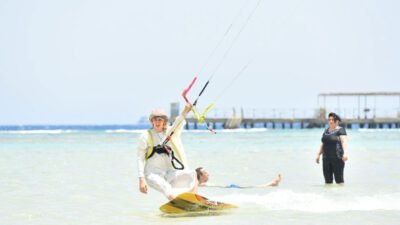
- Full‑size kite control (if conditions and aptitude permit). Under direct instructor supervision — often with a radio helmet allowing continuous real‑time coaching — the student may progress to launching a full‑size kite and practicing controlled flying while standing in shallow water.
By the end of Session 1, the student understands the safety systems, can launch and land a trainer kite, has begun to internalise wind‑window awareness, and has a clear picture of the progression path ahead. For a first responder accustomed to structured training, this systematic approach provides psychological comfort alongside skill acquisition.
How can a first responder begin kitesurfing in Hurghada, and what are the practical steps?
A first responder can begin kitesurfing in Hurghada by following a systematic five‑step process that mirrors the operational planning they already know: assess, select, schedule, secure, and execute.
Step 1 — Assess Your Readiness
You do not need to be a strong swimmer, an athlete, or have any prior board‑sport experience. The Al Ahyaa Lagoon is waist‑deep for hundreds of metres, and the impact vest provided by the school supplies flotation. Basic water confidence — the ability to remain calm when wet — is the only prerequisite. If you have specific concerns related to a service‑connected injury or condition, communicate these to the school in advance. Masters Surf School instructors are accustomed to adapting their approach to individual needs.
Step 2 — Select Your Course Package
For a complete beginner, the 12‑hour intensive course spanning four to five days is the recommended choice. This package covers the full IKO Discovery‑to‑Independent curriculum and provides the highest probability of reaching upwind riding within a single trip. Shorter packages (6 hours, 9 hours) are available but may leave you at an intermediate stage requiring a return visit to complete.
Step 3 — Schedule During the Optimal Window
The peak wind season runs from May through October, with particularly reliable conditions in May–June and September–October when winds are strong and tourist numbers are moderate. If your work schedule only permits travel outside this window, kitesurfing is still possible — schools operate year‑round and use larger kites to manage lighter winter winds — but you may experience occasional non‑rideable days.
Step 4 — Secure Your Booking
Visit the Masters Surf School website to select your dates and course package. You will pay a 30–50% deposit via a secure payment link to reserve your instructor and equipment. The remaining balance is paid in cash (Euros or US Dollars) on arrival. You will receive confirmation via email or WhatsApp, typically within hours. For direct inquiries, WhatsApp +20 112 482 3398.
Step 5 — Prepare and Execute
Pack swimwear, a lycra rash guard or long‑sleeve UV shirt (for sun protection and harness chafing prevention), polarised sunglasses with a strap, reef‑safe sunscreen SPF 50+, and a refillable water bottle. All kitesurfing equipment — kite, board, harness, helmet, impact vest, and radio earpiece — is provided. The school will confirm your hotel pickup time the day before your first lesson. Morning pickup for most Hurghada hotels is between 08:00 and 09:30, with a 15‑ to 40‑minute transfer to the lagoon.
Practical Checklist — Before You Book
- [ ] Confirm your travel window (May–October for optimal wind)
- [ ] Select the 12‑hour intensive beginner course for complete zero‑to‑independent progression
- [ ] Communicate any service‑connected injuries or concerns to the school in advance
- [ ] Book directly at with a 30–50% deposit
- [ ] Message the school on WhatsApp at +20 112 482 3398 with any questions about transfers, equipment, or accommodation
- [ ] Check Egypt visa requirements (30‑day tourist visa available on arrival for $25 USD for most nationalities)
- [ ] Pack: swimwear, rash guard, polarised sunglasses with strap, SPF 50+ reef‑safe sunscreen, water bottle, phone for capturing first rides
- [ ] Prepare mentally: the lagoon is shallow, the wind is side‑onshore, the instructors are IKO‑certified, and the progression is systematic
Kitesurfing for First Responders Frequently Asked Questions
You do not need to be a strong swimmer. Most learning occurs in waist‑deep water where you can stand. You will also wear an impact vest that provides flotation. Basic water confidence is the only requirement.
There is no strict age or fitness limit. Children can start from approximately 10–12 years old, and adults up to 70+ have successfully learned in Hurghada. If you have a service‑connected physical limitation, communicate this to the school; instructors can adapt the programme.
Most beginners need 9–12 hours of instruction over 3–5 days to ride independently upwind. Prior board‑sport experience (snowboarding, wakeboarding, skateboarding) can accelerate progress.
Wind‑less days in Hurghada are rare during the peak season (roughly 5–10 days per year). If conditions are genuinely unsuitable, the school reschedules your session at no extra cost.
Yes. A 2–3 hour discovery session (€60–€100) covers kite setup, safety, and trainer‑kite flying. However, you will not reach the board in a single session. For first responders seeking the full therapeutic benefit, the complete 12‑hour course is strongly recommended.
The structured, progressive nature of IKO instruction, combined with the shallow‑water environment and constant instructor communication via radio helmet, creates a controlled, predictable learning environment. Many participants report that the required present‑moment focus provides relief from intrusive thoughts during sessions.
While WS4WW and Stoke Therapy currently operate primarily in North America, Masters Surf School welcomes first responders and can structure private or semi‑private courses to accommodate groups from the same service background. Contact the school directly to discuss custom arrangements.
A 12‑hour IKO beginner course costs between €350 and €500 (approximately US $380–$550), including all equipment, certification, and hotel transfers. This is roughly 40–60% of the cost of an equivalent course in Europe.
Most nationalities can obtain a 30‑day single‑entry tourist visa for $25 USD on arrival at Hurghada International Airport. Some nationalities should apply for an e‑Visa online in advance. Check with your local Egyptian embassy or consulate.
Yes. Group bookings can be arranged for stations, units, or peer‑support groups. Semi‑private instruction maintains a maximum 1:1 or 2:1 student‑to‑instructor ratio, ensuring personalised attention while preserving the peer‑connection dynamic that is central to the therapeutic model.
🔹 Hurghada Kitesurfing for First Responders
The lagoon is flat. The water is warm. The wind blows side‑onshore nearly every afternoon from May to October. Your IKO‑certified instructor communicates with you through a radio helmet the entire time you are on the water. Every piece of equipment is provided. The only variable is your decision to act.
For first responders, kitesurfing offers something beyond a new skill: it offers a pathway back to the person you were before the calls, the shifts, and the accumulated weight of service. The research says water heals. The veterans and responders who have done it say the same. All that remains is for you to experience it yourself.
✅ Secure your place today: Visit and book your kitesurfing course in Hurghada. For immediate, direct communication, WhatsApp +20 112 482 3398. Your first ride across the Red Sea is one booking away.