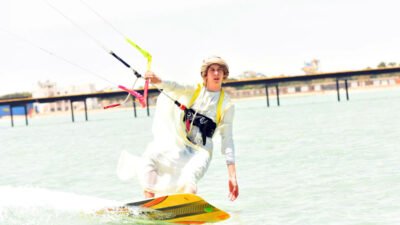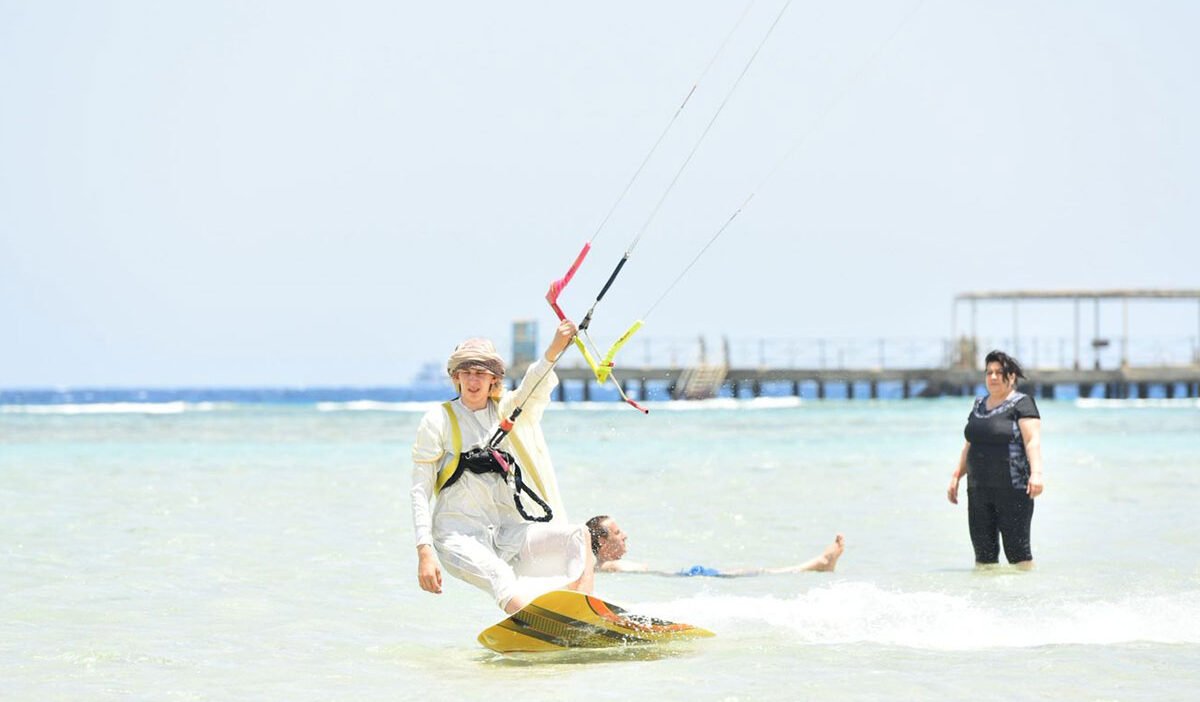
Learning to kitesurf is a structured journey that takes most riders between 12 to 20 hours of professional lessons to comfortably ride and turn in both directions. Early success, like standing on the board, often occurs within 6 to 12 hours of instruction. Your progress depends heavily on fitness, previous board sports experience, consistent wind conditions, and instructor quality. The average total cost to become independent ranges from $400 to $1,500, depending on lesson packages and equipment choices. While the sport has a moderate injury rate of 4 to 10 incidents per 1,000 hours, structured training with certified instructors dramatically reduces this risk.
How Long Does It Take to Learn Kitesurfing for a Complete Beginner?
Answer: For a complete beginner, it takes approximately 9 to 20 hours of professional instruction to learn kitesurfing to an independent level. Many riders achieve their first successful water start and short ride after 6 to 12 hours. Reaching comfortable independence — riding upwind, making turns, and self-rescuing — typically takes 14 to 20 hours or more.
The learning curve is divided into three main phases. Phase one (typically 2–4 hours) covers kite control on land and in the water without the board. Phase two (next 4–8 hours) introduces the body drag — moving through the water using only the kite’s power. Phase three (final 6–10 hours) focuses on the water start, getting on the board, and riding short distances.
You should expect to spread these hours across several days. Most schools recommend 2 to 4 hours of lessons per day over 3 to 7 days. Spacing lessons allows your body to rest and your brain to process the new skills.
What Factors Affect How Quickly I Learn Kitesurf?
Answer: Your learning speed for kitesurfing depends on five major factors: previous board sport experience, physical fitness, wind conditions, instruction quality, and equipment suitability. Riders with wakeboarding, snowboarding, or surfing backgrounds learn 30 to 50 percent faster than those without any balance-based sport experience.
Previous experience matters significantly. People who have done wakeboarding or snowboarding already understand edging and board control. Surfers know how to read waves and water conditions. This translates directly to shorter learning times.
Physical fitness affects fatigue. Kitesurfing requires core strength, leg endurance, and upper body stamina for kite control. Beginners who are not physically fit tire faster, leading to shorter effective lesson time per day.
Wind consistency is critical. Learning in locations with steady trade winds (typical wind ranges of 12–20 knots) speeds progress dramatically. Chaotic or gusty winds force you to fight unpredictable kite power and increase lesson hours.
Instructor quality determines efficiency. Certified instructors from organizations like IKO or VDWS use structured lesson plans. They follow standard progressions that maximize learning per hour. Uncertified instructors often skip fundamentals, which leads to bad habits and longer overall learning time.
Equipment suitability matters. Learning on the correct kite size for your weight and wind conditions prevents frustration. Too much power overwhelms you; too little power means you cannot get up. Most schools provide properly sized beginner gear.
What Are the Specific Steps to Learn Kitesurfing in a Lesson?
Answer: Learning to kitesurf follows a structured 5-step progression: (1) kite setup and safety systems, (2) land-based kite control, (3) body dragging in water, (4) water start and short rides, (5) riding in both directions with self-rescue skills.
Step 1: Theory and Setup (1–2 hours). You learn wind theory, kite anatomy, safety releases, and equipment setup. This happens on the beach before any kite flying begins.
Step 2: Land Kite Control (2–3 hours). You start with a small trainer kite (2–3 meters) to learn basic steering. Then you progress to full-size inflatable kites (5–9 meters) on the beach. You learn launching, landing, and the power zone — the area downwind where the kite generates maximum pull.
Step 3: Body Dragging in Water (3–5 hours). You enter shallow water without the board. The goal is learning to move through the water using kite power alone. You practice upwind body drag (returning to your board) and downwind drag (to leave a dangerous area).
Step 4: Water Start and Board Riding (5–8 hours). You add the board and learn the “water start” — positioning the board on your feet, steering the kite to generate power, and standing up on the board. Early attempts typically last 3 to 10 seconds. After 4 to 6 hours of practice, many riders can ride 50 to 100 meters in a straight line.
Step 5: Independent Riding (3–6 hours). You learn to ride in both directions, change directions without falling, and ride upwind — the ability to return to your starting point without walking. You also master self-rescue techniques for getting back to shore if the wind drops.
How Many Lessons and Hours Do I Need to Learn Kitesurfing?
Answer: Most beginners need between 6 and 20 hours of professional lessons, typically taken over 3 to 7 days. A 6-hour introductory course gets you through kite control and basic body dragging. A 12–15 hour complete course takes most riders to independent riding in both directions.
Lesson Package Options:
| Lesson Hours | What You Achieve | Typical Difficulty |
|---|---|---|
| 6 hours | Kite control, body drag, basic safety | Beginner level |
| 9–12 hours | Water start attempts, short rides in one direction | Intermediate beginner |
| 12–15 hours | Reliable water start, riding both directions | Advancing beginner |
| 15–20+ hours | Upwind riding, independent practice without instructor | Independent |
Average Costs by Lesson Type:
- Private 3-hour lesson: $150–$250
- Group 3-hour lesson (3–4 students): $80–$150
- Complete beginner package (12–15 hours): $500–$1,200
- Intensive 3-day course (15 hours): $600–$1,500
Most schools recommend booking a 9-hour package (typically 3 days of 3-hour lessons) to reach the water start phase. From there, you decide whether you need additional hours or can practice on your own.
Can I Learn Kitesurfing Without Lessons or by Watching Videos?
Answer: No. Learning to kitesurf without professional lessons is dangerous and strongly discouraged. The kite generates enough power to lift you into the air or drag you across obstacles. Kiteboarding injury rates range from 4 to 10 incidents per 1,000 hours of practice, but the majority of serious accidents occur among untrained riders.
Here is why lessons are mandatory for safety. The kite produces power that scales with wind speed — a 12-meter kite in 20 knots generates over 200 pounds of pull. Without proper training, you cannot predict or control this force. Certified instructors teach three critical safety systems: the quick release (immediately depowers the kite), the leash system (keeps the kite attached safely), and self-rescue techniques (returning to shore when the wind fails).
Additionally, professional instruction provides accelerated learning. A 3-hour lesson covers more ground than 10 hours of self-guided trial and error. Instructors correct mistakes immediately, preventing bad habits that take months to unlearn.
What online resources can help. While video cannot replace lessons, YouTube tutorials from channels like Kitesurf College or MACkiteboarding help you understand concepts before your first lesson. Use training kites on land (2–3 meter, 2-line kites costing $50–$150) to develop basic steering reflexes. But never attempt to launch a full-size inflatable kite without supervision.
Is Kitesurfing Harder Than Other Watersports?
Answer: Kitesurfing has a steeper initial learning curve than windsurfing but becomes easier at the intermediate level. Beginners typically find kitesurfing harder than wakeboarding or SUP but easier than surfing, where wave reading adds complexity.
Comparison Table: Learning Difficulty
| Sport | Beginner Difficulty (1–10) | Time to Basic Fun | Key Challenge |
|---|---|---|---|
| Kitesurfing | 7 | 12–20 hours | Kite control + board simultaneously |
| Windsurfing | 6 | 8–15 hours | Rigging and balancing the sail |
| Wakeboarding | 5 | 2–6 hours | Pull from boat, no kite to manage |
| Surfing | 8 | 40+ hours | Paddling out, wave timing |
| SUP | 2 | 1–3 hours | Balance on calm water |
The challenge with kitesurfing is juggling two distinct skill sets. You must steer the kite with one set of mental resources while balancing on the board with another. This coordination takes 10 to 15 hours to become natural. However, once the kite control becomes automatic, advancing to jumps and tricks happens faster than in sports like surfing, where wave selection remains perpetually difficult.
Body mechanics differ from expectations. Kitesurfing does not require enormous upper body strength. The pull comes from the kite, not your arms. You steer with small hand movements and use your core and legs to absorb power. This makes kitesurfing accessible to smaller and lighter riders, provided they choose the correct kite size.
What Safety Measures Are Essential When Learning to Kitesurf?
Answer: Four safety measures are essential: (1) taking lessons from a certified instructor, (2) always using a quick-release leash, (3) learning proper self-rescue, and (4) choosing locations with shallow water and side-shore wind. Following these rules reduces injury risk to the baseline rate of 4 to 10 injuries per 1,000 hours of practice.
Certified instruction is non-negotiable. IKO (International Kiteboarding Organization) or VDWS certified instructors follow safety-first progressions. They teach you to identify dangerous wind conditions, perform equipment checks, and use emergency depower systems before your first water session.
The quick-release leash saves your life. Every modern kite has a quick-release mechanism that instantly depowers the kite. You must practice releasing it on land until the motion becomes automatic. Never remove or disable this safety system.
Self-rescue techniques get you home. Learn to wrap your lines around the kite, use the kite as a sail, and body drag back to shore. This works even in zero wind and is essential when the wind suddenly drops or shifts direction.
Choose beginner-friendly launch spots. Learn in:
- Knee-to-waist deep water (not deep enough to drown if knocked down)
- Side-shore wind (blowing parallel to the beach, not directly onshore or offshore)
- Uncrowded areas with soft sand beaches, not sharp rocks or shells
- Locations with steady, predictable winds (12–20 knots ideal)
Injury patterns to know. Most kitesurfing injuries occur in the lower extremities (foot, ankle, knee) — about 50 percent of all injuries. Head impacts account for 11 percent of recorded injuries. Wearing a helmet and impact vest during lessons significantly reduces these risks.
What Is the Most Realistic Timeline From Beginner to Independent Kitesurfer?
Answer: A realistic timeline from absolute beginner to independent kitesurfer is 3 to 12 months, assuming you take 12 to 20 hours of lessons then practice 2 to 4 hours per week. The fastest path is 2 weeks of intensive training (5–6 days with 3–4 hours daily) combined with 5–10 additional practice sessions.
Here is a month-by-month breakdown:
Week 1–2: Lessons Phase (10–15 hours of instruction).
- First 2 days: Kite control, safety systems, body dragging.
- Days 3–5: Water start attempts. You stand up for 2–15 seconds before falling.
- Days 5–7: Short rides (50–200 meters) in one direction, learning to stop.
Month 1–2: Consolidation Phase (6–10 additional practice sessions).
- Goal: Ride 500 meters without falling.
- Goal: Ride in both directions (port and starboard tack).
- Goal: Change directions without stopping (the “turn”).
Month 3–6: Independence Phase (8–15 practice sessions).
- Riding upwind to return to starting point without walking.
- Launching and landing without assistance.
- Self-rescue and emergency procedures mastered.
- You can now practice alone safely.
Month 6–12: Progression Phase.
- Learning small jumps and transitions.
- Trying different board types (twin-tip, directional, foil).
- Exploring new spots and wind conditions.
What “independent” means. You can drive to the beach, check wind forecasts, rig your equipment, launch safely, ride upwind and downwind, self-rescue, and pack up without help. You understand wind limits for your skill level — typically riding in winds up to 25 knots maximum for intermediates. You recognize when conditions exceed your ability.
Practical Checklist for Learning Kitesurfing
Before Your First Lesson:
☐ Learn to swim confidently in open water (minimum 200 meters).
☐ Get basic fitness — core exercises, leg squats, light cardio.
☐ Watch 3–5 beginner tutorial videos to understand terminology.
☐ Book lessons with IKO or VDWS certified school only.
During Your Lesson Week:
☐ Take lessons in 2–4 hour blocks, maximum one session per day.
☐ Eat and hydrate before each session — kitesurfing burns 500+ calories per hour.
☐ Wear helmet, impact vest, and wetsuit appropriate for water temperature.
☐ Communicate with your instructor before launching — never assume readiness.
After Becoming Independent:
☐ Practice at designated kite beaches only — never launch near swimmers.
☐ Check wind forecast (sites like Windy or Windfinder) before every session.
☐ Ride with a buddy when possible — use the “buddy check” system.
☐ Replace worn equipment — frayed lines or leaky bladders cause accidents.
Key Takeaways
- Most riders need 9 to 20 hours of professional lessons to reach independence.
- With consistent practice 2–4 days per week, you can ride independently in 3–6 months.
- Previous board sports and good physical fitness cut learning time by 30–50 percent.
- Learning in steady 12–20 knot winds with shallow, flat water accelerates progress significantly.
- Never skip professional lessons — the injury rate for untrained beginners is substantially higher than for trained riders.